
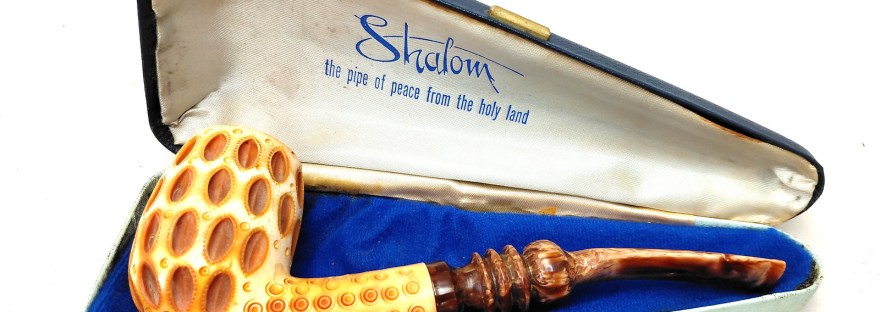
I’ve worked on a few pipes made in the Shalom pipe factory, Israel’s only pipe producer best known for its Alpha line. The pipe on the bench today is not an Alpha but a Shalom meerschaum Bent Billiard instead.
As you can see in these pics, the pipe was in fairly good estate condition when it arrived in the shop. This told me that the pie had been well cared for and stored in the original hard case when not in use.
The pipe’s steward had no concerns about the pipe, but wanted it cleaned and waxed to keep it looking its best. From a restorer’s perspective, I noted the crust of carbon on the rim of the bowl and what looked to me like a rather extreme bend in the intricately turned Acrylic stem. Both of these would need addressing. I also identified another problem that would need to be corrected before it became a larger issue. See if you can find it in this initial series of images.


The chamber was very clean, without any cake buildup to worry about, which was a welcome change. It’s surprisingly common for pipe smokers to apply the same care and feeding rules to both briar and meerschaum pipes, but in truth the two are very different beasts with different requirements.
A meerschaum pipe, being carved from essentially a soft rock that cannot burn, requires no layer of cake in the chamber to protect the walls from heat damage. In fact, cake buildup in a meerschaum pipe can, in extreme cases, cause the bowl to crack or split as the carbon expands and contracts at a different rate than the meerschaum.
With how well cared for the stummel was, I was not surprised to find the stem just as clean. I ran a few pipe cleaners dipped in 99% isopropyl alcohol through it to clear out a tiny bit of dirt and debris from the stem’s airway.

Now back to our little visual pop quiz – did you spot the tiny perforation in the stem just behind the lower button? This close-up shot reveals the troublemaker. At just under 1/16″ of an inch round, this tiny hole goes right through the lower bite zone. I slid a piece of brass rod through the hole and took a few pics to show the pipe’s steward.


Thankfully, the stem here is Acrylic, so the hole could be patched with a drop of CA glue. CA stands for CyanoAcrylate, which is a close relative of Acrylic, so the glue bonds very well to the stem and leaves a smooth, invisible repair.
I didn’t bother blocking the airway here, but rather relied on surface tension to hold the drop of glue in and around the hole without dribbling through to block the airway. This worked surprisingly well, though if any glue had made it into the V-Slot, I could have tidied it up fairly easily.

I set the stem aside carefully to let the CA glue cure. While I waited, I tidied up the stummel, sanding the chamber walls lightly to ensure a smooth finish and also scraping the crust of carbon from the rim.
As this pic shows, the carbon had literally sat on top of the rim, without soaking into and discolouring the meerschaum. We’d have to wait and see if some rim darkening would appear after waxing the meerschaum, but for now, it looked no darker than the rest of the stummel.

A meerschaum pipe is waxed in the factory when the pipe is made, and should be repeated every year or two, depending on how much use the pipe gets. Not only does waxing give the meerschaum a warm sheen and a lovely honey scent, but it also brings out the much-loved colouration in a meerschaum pipe. Meerschaum is a porous mineral, and these pores pull the liquid wax deep into the stummel through capillary action. The wax in turn liquifies any tobacco tars the pipe has absorbed through use and pulls the colour to the surface. With enough use and regular waxing, a snow white meerschaum turns to a dark amber-brown.
Meerschaum can be waxed using one of two methods. The most effective method is immersion, in which the stummel is soaked in melted beeswax, allowing the meerschaum to sit in the wax long enough to absorb its fill. I use a two-cup electric crock pot as my wax pot. Its cheap, easily sourced and fits all but the largest meerschaum stummels.
For those without wax pots or when dealing with very large pipes, the second waxing option is mopping melted beeswax onto the warmed surface of the stummel. This involves heating the stummel with a heat gun or hair dryer, then applying the wax with a cotton mop or pipe cleaners. The mopping and heating are repeated until the entire stummel has been treated and can absorb no more wax. The mop method takes considerably more time to accomplish, which is why I prefer the immersion method.
Regardless of the method employed, it’s important to keep the wax out of the stummel’s chamber and airway. This pic shows the stummel of today’s pipe prepped for waxing, with a cork twisted into the chamber and a modified push-pull tenon inserted into the shank.

Then it’s into the wax pot for a good soak!

The stummel must be turned over in the wax regularly to ensure even coverage. I use a bent section of coat hanger for this, but just about anything will work. After about five minutes on each side in the hot wax, the stummel was transformed from the mostly white pipe in the previous image to a honey-brown colour punctuated with darker sections in the carving.

When the colour no longer changed and the meerschaum had absorbed as much wax as it could hold, I fished the stummel out of the wax and laid it on a clean towel to cool enough to handle.

When the meerschaum could be handled without burning my fingers, I removed the cork and shank plug and hand buffed away the excess wax by hand with the towel. I then set it aside to cool completely.
While the stummel cooled, I finished up the repair work on the stem. After filing the repaired area flush with the surrounding Acrylic, I sanded the stem to 2000 grit to prepare the stem for buffing. I also took a quick minute to correct the bend in the stem. After warming the stem over the heat gun until pliable, I gently relieved the bend until the top button was more or less in line with the rim. A quick run under cold water set the new shape. The idea here is to add enough bend to the stem to allow the bowl to be held upright when the pipe is clenched in the teeth. Over-bending a stem only makes smoking the pipe awkward and increases the risk of burning out the bowl due to focusing the heat of the burning tobacco at the rear upper chamber wall.
When I was happy with the stem repairs, I mounted the stem to the now cool stummel and took the pipe to the buffers where I polished the stem (NOT the meerschaum) with both Red Tripoli and White Diamond compounds on their respective wheels. Acrylic stems don’t need to be waxed, but I typically add this extra step in out of habit.
The refreshed pipe is looking its very best after only a short time on the bench. The stem is once again whole and shines like glass after its polishing while the meerschaum stummel is well on its way to achieving the sought-after patina that meerschaum lovers have been chasing for centuries. Its also clean, fresh and smells gently of honey thanks to the beeswax.
I hope you have enjoyed watching this Shalom meerschaum reach its full potential. I love seeing the colour change as the meerschaum sits in the wax pot, and I’m certain that this pipe’s steward will appreciate the glow up. With regular care and maintenance, this pipe should serve its steward faithfully for many years to come.
Until next time, Happy Piping! Here’s the finished pipe.


