
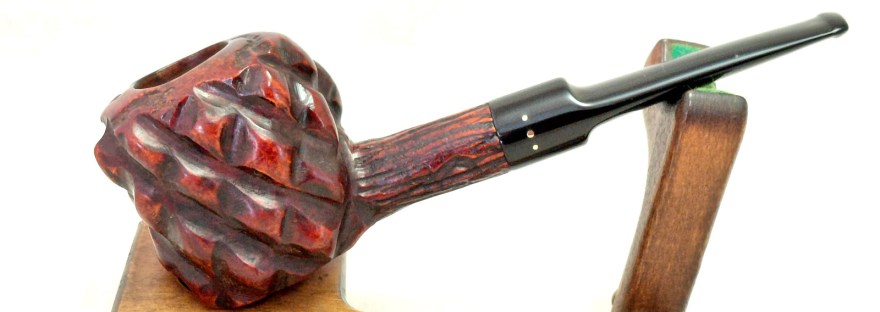
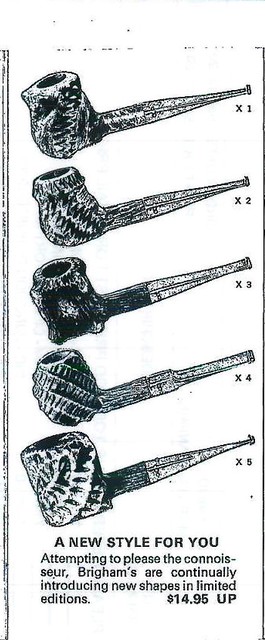
The Brigham Experimental line of pipes was officially introduced in the early 1960s and featured some rather fantastical shapes and carving styles. Brochures from the period illustrate five such shapes, as seen in the image below, but other shapes and styles are known to have been produced.
But how did Brigham land on the styles and shapes they would eventually produce? Today, this would be called “product research and development”, though at the time, I suspect Roy and Herb Brigham would have simply called their activities “fiddling” (Herb was especially known for sitting at a workbench and carving a pipe shape “just for fun” well past his official retirement date).
However that process was undertaken, the development of an entirely new line of pipes takes time. it stands to reason that early versions of the pipes existed at one point. I had never worked on one of these proto-Experimental pipes – until now.
The pipe in today’s blog was sent to me for a bit of sprucing up by a fellow Canadian pipe lover. I’d describe it as a take on a Poker shape, featuring a crisscross lattice style carving (that reminded me somewhat of a pineapple). As this first series of images illustrates, the pipe was actually in rather good estate condition, though the briar was dull and a bit grimy, and the Vulcanite stem had oxidized to a flat greyish-yellow.


The stem carries the vertical 3-Dot pattern of the Brigham VIP grade of pipes, consisting of a larger Dot in the centre and smaller Dots on the top and bottom.

And here is where things get interesting from a pipe history point of view. The smooth underside of the shank is stamped “Brigham” over “CAN. PAT”. The Patent number is, however, obscured by what may or may not be intentional scratches. This Country of Manufacture stamp was used by Brigham from 1938 to 1955 while the Brigham System patent was active. I’d suggest that this early Experimental shape was carved at the end of this period, likely 1955 or early 1956 before the stamp was changed to “Brigham” and “Made in Canada”.

Remarkably, the original aluminum System tenon was intact and undamaged. These parts haven’t been made since 2001, so replacing a damaged aluminum tenon is becoming more difficult as time goes on.

As with all restorations, I began work on this Brigham by cleaning the pipe inside and out. A few cotton swabs and pipe cleaners dipped in 99% isopropyl alcohol removed a very light amount of dirt and tars from the shank and airway. The pipe had evidently been rather lightly used and had no cake buildup in the chamber. I gave the chamber walls a quick sanding to smooth out any irregularities.

This next image really highlights the amount of dirt dust, grease and old wax on the exterior of the pipe. A scrub with Murphy’s Oil Soap removed these contaminants and noticeably improved the stummel’s appearance.

I refreshed the original finish by applying a two-colour stain, first wiping on a coat of Mahogany stain followed by a topcoat of Dark Brown. I flamed the stain to help set it, then wiped away the excess, allowing the red undercoat to shine through on the high parts of the carving.

A wipe of mineral oil really brought the finish to life. I allowed the oil to sit on the briar for only a minute or two before hand buffing away the excess with a soft towel.

During all the work on the stummel, the stem had been sitting in a bath of Oxyclean and warm water to raise the oxidation and make it easier to remove. I scrubbed the stem with Magic Eraser to get it back to black, then used a handful of pipe cleaners and more alcohol to clean out the airway.

I wet sanded the Vulcanite to 2000 grit to prepare the stem for final buffing. When I was happy with the state of things, I assembled the pipe and took it to the buffing wheels for a run on the Red Tripoli and White Diamond wheels. The buffing erased the last sanding scratches and brought up the shine. A few light coats of Carnauba wax completed this quick restoration while adding a bit of UV protection.
The finished pipe is looking great after its time on the bench. Even though the pipe was well cared for by its previous stewards, this quick glow-up took this early Brigham Experimental design from just an old pipe to a bona fide collectible that any Brigham fan would be happy to add to his or her rack and rotation. I’m happy to report that the pipe’s current steward feels the same!
Until next time, Happy Piping! Here’s the finished pipe.


Another Beautiful work Charles…
In your last repair you spoke of the condenser I believe that is the metal portion in the stem joining to the bowl.
I am guessing this does something to reduce moisture… but I am not sure…
Thanks…
Blessings… Rick
LikeLiked by 1 person
Hi Rick. In pipe terms, a condenser (or stinger) is a metal (usually aluminum) part, usually mounted to the end of the tenon. The metal is cooler than the smoke, so moisture droplets form on the surface of the condenser as the smoke passes through the shank and into the stem. This is the same process that creates water droplets on the outside of a glass of iced tea. In practice, stingers have been shown to be less effective than advertised, though they do collect a bit of moisture.
The Brigham System shown in this blog post is designed to pull the smoke through a tube of raw Rock Maple (the Brigham filter). The raw wood absorbs water from the smoke as it passes through the tube. This system is much more effective at removing moisture and by doing so, reducing tongue bite.
LikeLiked by 1 person
Thank you….
LikeLike