
As regular readers here can attest, I’ve worked on many, many Brigham pipes over the years, both vintage and modern. I’ve got a soft spot for the brand, especially for the vintage pipes made in Toronto, Ontario, so when I was sent a 1980s Brigham 309 Apple for restoration, I was looking forward to returning it to active service in its steward’s rack and rotation. As it turned out, this would prove a bit trickier than I had originally imagined.
This series of images shows the pipe as it looked when it arrived at the shop. The briar looked a bit worn and faded, with little visual distinction between the smooth finish and the rusticated areas. The original Vulcanite stem was oxidized to a flat grey-green colour, with tarnish obscuring the iconic brass Dots inlaid in the stem. The biggest issue, though, was the chunk of Vulcanite missing from the button end of the stem.


The smooth underside of the shank is stamped “309” and “Brigham ” over “Canada”. The shape code tells us that this pipe is a 3-Dot, Shape 09 (Apple) while the style of COM stamp dates the pipe to the 1980s.

Unlike many vintage Brigham pipes, the aluminum tenon on this Apple was in excellent condition under a thin layer of dirt and grime. These old tenons are particularly prone to oxidation, chips and cracks, especially if a wet Rock Maple filter is left in the stem for a long time.
Brigham stopped using the aluminum tenon in about 2001 when the composite tenon was introduced, making new replacement parts impossible to find. If this old tenon had been damaged, I’d have had to find a donor stem from which to salvage a tenon. Thankfully, that was not the case here, and I’d be able to transplant this tenon into the new stem.

As with all of my restorations, cleaning the pipe is Step 1. After dipping a cotton swab in 99% isopropyl alcohol, I made a preliminary swipe around the inside of the shank mortise and came away with the silver grey residue seen below.
This is not tobacco tar, dirt or the usual grime found inside a used smoking pipe. This is what’s left behind when aluminum oxidizes. I’d guess that the pipe was still a bit wet when it was last put away. I seem to have caught it early, though, as a larger buildup of this gunk can bond the tenon to the briar, making it very difficult to remove the stem from the shank and often leading to damage to the tenon.

I worked on the shank and airway to remove all traces of the aluminum and a light amount of tars and dust from the stummel’s internals. The chamber had been reamed back to briar before I recieved the pipe, so there was no need to do that again now.

When the inside of the stummel was clean, I did the same for the outside, scrubbing the briar with Murphy’s Oil Soap to remove years of dust, oils and old wax from the surface.

I set the stummel aside to dry while I worked on preparing the original aluminum tenon for transplant into the new stem. Removing the tenon from the original stem was easy enough as I didn’t need to worry about damaging the stem in the process. I simply heated the Vulcanite at the stem face over my heat gun until it became pliable, then twisted the tenon out of the stem with a pair of padded pliers.

A bit more work with cotton swabs and alcohol cleaned up the tenon nicely. Note the hole in the knurled end of the tenon. This is from the first brass pin, or Dot, installed in the stem. It acts as an anchor for the tenon, holding it securely in the stem face. The remaining Dots are set into the Vulcanite alone.

I have a few New Old Stock Vulcanite stems that were salvaged when Brigham closed its Toronto factory after moving pipe production to Europe in the early 2000s. I selected one of these stems for this project and used the original stem as a template to mark the correct length.

After cutting the new stem to length and squaring off the stem face, I used two drill bits to recreate the Brigham System. The first drill bit opened up the airway to make a pocket into which the Rock Maple filter would fit. The second, larger bit drilled a mortise into which I would glue the aluminum tenon.

A test fit showed that everything was good to go.

I like to use JB Weld high-heat epoxy for these vintage Brigham stems as the aluminum tenon can become quite warm during use. A drop of black epoxy colourant helps the adhesive blend into the surrounding Vulcanite.

After applying the epoxy to both the end of the tenon and the inside of the stem mortise, I slid the parts together and lined everything up. Then the pipe was clamped upright in a small padded vise to let gravity help keep the stem face flat against the end of the shank while the epoxy cured. A wrap of masking tape added a bit of extra insurance against the parts moving out of alignment.

I let the epoxy cure overnight, then twisted the new stem out of the shank and chased the airway with a drill bit to remove the inevitable squeeze-out from the inside of the stem. Then it was time to add the iconic Brigham Dots to this stem.
The Dots were traditionally drilled freehand by the Brigham craftsmen, so I did the same, drilling three 1/16″ holes into the side of the stem in a triangle pattern.

Short segments of brass rod were then glued into the holes. A drop of CA glue secured the brass rods in place.

After the glue cured, I filed the rods flush to the surrounding Vulcanite. You can see the results below.


And this is when I discovered something was wrong with the Vulcanite stem I had selected from my supplies. Ugh! This close shot reveals a star field of tiny pits and cracks in the Vulcanite. This is presumably the result of age and perhaps poor storage conditions on what may have begun life as sub-standard Vulcanite.


I’ve come across this issue a few other times on very heavily oxidized stems. Even with prolonged sanding, these pits are impossible to remove. The only route forward was to start over with another Vulcanite stem blank. How frustrating!
I won’t bore you with rewriting all the details of the process as it is exactly the same as the first time with the notable exception of a much newer stem blank. This series of images presents a speed run of sorts to get this project back on track.


Alright! After completing the catch-up work, I used a series of files to size the new stem to the shank and refine the taper. When I was happy with the state of the union, I sanded the new stem with 220 through 2000 grit to remove the file marks and sanding scratches inpreparation for final buffing and waxing.

Before that, though, I took a moment to refresh the finish on the stummel. I applied a coat of Fiebing’s Medium Brown leather dye to the briar, followed by a wipe of mineral oil. The oil helps to set the stain while adding depth and pop to the finish.


I let the oil sit briefly on the briar before buffing away the excess with a soft towel. After a bit of rest to let the briar’s moisture level equalize, I mounted the stem to the shank and took the complete pipe to the buffers for a run on both the Red Tripoli and White Diamond wheels. These erased any last sanding marks and brough up the shine. A few light coats of Carnauba wax completed the process, adding more shine and some UV protection for the restored pipe.
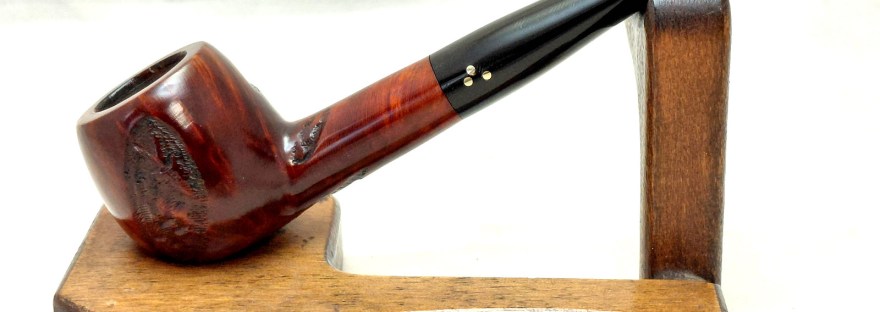
The casual observer might be forgiven for not recognizing the finished pipe as the rather lacklustre briar that had arrived on the bench jut a few days earlier. The stummel, no longer faded and drab, shines a deep reddish brown while the Vulcanite stem gleams a deep glossy black against which the trio of Brigham Dots sparkle. With a modicum of care and feeding, this 1980s Brigham 309 Apple should serve well and faithfully for another 46 years.
I hope you enjoyed watching this estate pipe revival project. Despite being momentarily blindsided by a bad stem, this vintage Brigham turned out very nicely indeed. It has been returned to active service in its new steward’s rack and rotation.
Until next time, Happy Piping! Here’s the finished pipe.


2nd time is the charm! Beautiful work. As my old shop teacher would say when we glued wood: “looked like it growed that way”.
LikeLiked by 1 person
Thanks! Everything came out alright in the end, but I’ll be scrutinizing my Vulcanite stems a bit more closely for a while! 😄
LikeLike