
I was recently contacted by a DadsPipes client with a unique project – creating a Churchwarden pipe from an orphaned briar bowl. I’ve made stummels into Churchwarden pipes before, but this bowl was a bit outside the norm as it had once been part of a German Hunter pipe.
As you can see from this initial series of images, the bowl was in fairly good estate condition. It carried a few dents and dings, testament to both its past history and its time rolling around in a drawer. The bowl was a slightly elongated round shape and featured a briar foot on the bottom and the carved image of a stag on the front of the bowl.


The rear of the bowl is stamped “Georg Huber” over ” Munchen” over “66th L66” and “Bruyere Guarantie”. I couldn’t find much information on Georg Huber other than that he was a founding member of the John Aylesbury group of independent tobacco merchants in Germany. If anyone can add any more information about this pipe maker, please comment below!


Looking closer at the shank of this Huber pipe bowl reveals a flat area on one side. This would not have been a big problem for the original hunter pipe setup, but it was definitely a stumbling block for this project.
As I mentioned above, the pipe’s steward wanted this bowl turned into a Churchwarden that accepted 6mm filters. The shank was only about 11mm in diameter at the narrow end, so I proposed adding a shank extension of some kind and housing the filter in the stem tenon as there was insufficient real estate in the shank.

Here is a pic of the various parts laid out in a mocked up assembly.


Rather than rely on fragile Acrylic to hold the shank extension onto the end of the briar shank, I’d use a short length of stainless steel tubing to reinforce the joint.

The first job here was to shorten the shank to eliminate the flat area. This left the shank rather stubby, but that woud be improved visually by the Acrylic shank extension.

And here is the first major hurdle I’d have to overcome to complete this build. As you can see in this pic, the airway was drilled well off-centre to the shank. Attaching the shank extension to this airway would leave the Acrylic part hanging out in space on one side and leave the briar exposed on the opposite side. No bueno!

After a bit of thought, I concluded that the only way forward was to fill the existing airway and drill a new airway in the centre of the shank. This is a risky operation, as the airway had to enter the bowl at the same spot as the original airway. If it didn’t, I’d be left with a bowl with two draft holes in the chamber…. Yikes!
To fill the existing airway, I turned a scrap of briar to a 1/8″ diameter rod and glued it into the airway with a bit of JB Weld high heat epoxy.

I set the bowl aside overnight to allow sufficient time for the epoxy to cure completely before nipping off the excess briar rod and facing the shank smooth and flat. The lines drawn on the outside of the bowl in this pic show the angle of the airway – a good reference for drilling the new airway.

To give myself some wiggle room with drilling the new airway, I first drilled a pilot shaft with a 1/16″ drill bit from the centre of the shank to the draft hole in the chamber. This pilot shaft acted as a guide for the 1/8″ drill bit that followed.

As this pic shows, I somehow managed to drill into the exact centre of the draft hole (!). Those guide lines drawn on the outside of the shank really did help get the angle right.

The edges of the shank chipped a bit when I was cutting and facing it, so I dug out a thin brass shank band that fit snugly onto the end of the shank and covered the damaged briar. Here you can also see the prepared length of stainless steel tubing and the Acrylic shank extension prepped for assembly.

I dry-fit the parts together to ensure they fit tightly without air gaps, then mixed up a small amount of two-part epoxy and assembled the parts for the last time.


While the bowl sat in the vise waiting for the epoxy to cure completely, I worked on the stem for this Churchwarden. I used a precast 8″ long Vulcanite stem and a Delrin tenon I made up on the lathe. Both the tenon and stem face are drilled out to make room for the 6mm filter.


As with the stummel, I dry-fit the parts to make sure they fit together properly, then glued everything up using more two-part epoxy.

I left the pipe overnight to give the epoxy time to cure completely. When I came back to it, I chased the stem with a drill bit to remove any epoxy squeeze-out from the mortise and airway. Then it was time to file and sand the rough-cast stem to remove the casting marks and prepare the stem for final polishing.
I sanded the stem and shank extension with 220 through 2000 grit sandpapers. Each successive grit removed the scratches left by the previous grit. If deeper scratches were found, I backtracked a grit or two to make sure I had a perfectly smooth stem ready for buffing.

The last task before buffing and polishing was to add a gently bend to the stem. This is done in the same way I bend shorter stems. A pipe cleaner (in this case a long Churchwarden cleaner) was slipped through the airway to prevent it from kinking or collapsing while I heated the Vulcanite until it became pliable. When the stem was soft enough, I introduced the desired bend before setting the new shape permanently by running the stem under cold water.

Finally it was time to take the complete pipe to the buffer where stem and stummel were treated to a run on both the Red Tripoli and White Diamond wheels. The buffing erased any lingering sanding scratches and brought up the shine. A final few coats of Carnauba wax added more shine and a layer of UV protection for the newly restored pipe.
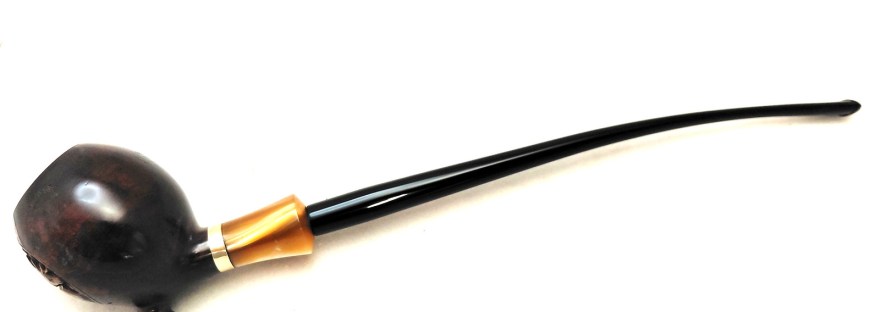
The finished pipe is about as far from a Bavarian style Hunter pipe as one can get. I’d describe the new Churchwarden as a forward-canted, Footed Apple (or perhaps Egg?) with Acrylic shank extension. Whatever you call it, the pipe is quite eye-catching with its reddish-brown bowl set off by the brass band and Gold Swirl shank extension and the deep black Vulcanite stem.
The pipe has been returned to its steward, who is thrilled to have been able to put a random bowl to use in a complete pipe and add a Churchwarden to his collection at the same time. He also reports that the pipe smokes well, which is always the goal. May he enjoy it for many trouble-free years!
I hope you enjoyed this Franken-pipe project. It’s been a while since I created a pipe like this, and though it presented a few challenges, I’m very pleased with the results. Do you have an orphaned bowl in your pipe collection that you’d like to see used again?
Until next time, Happy Piping! Here’s the finished pipe.


