
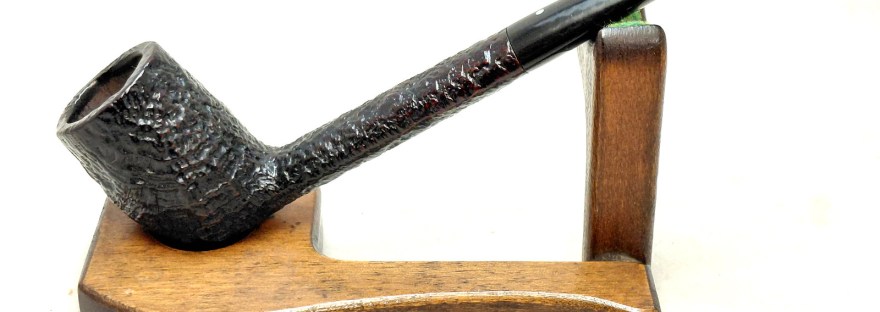
It’s not uncommon in my line of work to come across pipes that show signs of previous repairs. Even well cared for pipes need a bit of work now and then, with tenons and stems being the most commonly damaged parts.
The Dunhill Shell Briar on the bench this week is a good example. Overall, the pipe was in excellent condition when it arrived on the bench. The briar was clean, the stem free of tooth chatter or dents and was only very mildly oxidized. With such a lack of obvious issues, can you spot the area of concern in the pics below?


The flat underside of the shank is stamped “ES F/T” followed by “Dunhill” over “Shell Briar”. Next comes “Made In” over “England7” at “4S” (with the 4 in a circle).


If I’ve decoded the stamps correctly, using the Dunhill dating guide on Pipephil.eu, this pipe is a Canadian shape (ES) with a Fishtail stem (F/T) in a Group 4 size (4S). made in 1957. The pipe has clearly been cared for over the years – I doubt I’ll look this good at 69 years old!
The meticulous care given to the pipe is important to its current steward, who prefers to keep the pipes in his rack and rotation as close to factory original as possible. The reason this Dunhill was sent to me for work is the somewhat awkward transition between shank and stem.
Dunhill likes to maintain straight, parallel lines through the transition area, but as you can see in the pics below, this pipe had a noticeable taper at the end of the otherwise straight-sided shank where it met the stem.


Placed along a straight edge, the extent of the tapering becomes clear.

My best guess for the reason behind this situation is that at some point this pipe was fitted with a replacement stem that was slightly undersized for the shank. Why the repair shop that did the work didn’t simply cut down a larger stem to match the width of the shank is beyond me, but they didn’t. Instead, they cut down the shank to match the size of the available replacement stem, which is, in my opinion, a cardinal sin of pipe restoration.
To re-establish the straight parallel lines of the shank/stem transition, I’d have to do several things – cut off the tapered section of shank, re-face the shank end to square it to the airway, deepen the shank mortise to compensate for the removed briar, and finally fit a new stem with White Spot.
Since the pipe was already quite clean inside and out, I could move straight to the tasks above, starting with marking out the cut line on the shank. I’d have to remove about 3/16th of an inch from the length of the shank to remove all of the tapered area. Thankfully, the stamps are far from the end of the shank so my messing about won’t endanger the pipe’s nomenclature in the slightest.

I got the ball rolling by carefully drilling the shank mortise 3/16″ deeper, using the existing mortise as a guide. With that done, I borrowed a facing bit and guide pin from my pen-making supplies to both shorten and re-face the shank in one operation. I set the depth of the guide pin to match the depth of the shank mortise. This allowed the pin to act as a depth stop. When the pin bottomed out in the mortise, the shank would be cut to the correct length.

Not bad!


I have to admit that, while the shortening and refacing looks quick and simple in the pics above, it was a bit of a sphincter clenching moment for me. If the bit had wandered at all or jammed in the briar, I could have broken the shank or chipped the stem face. I said a silent thanks to the pipe gods when the operation was over!
Now that the shank was once again taper-free, I could start thinking about fitting the new stem. The old stem was too small to be useful here (as it was originally), so I set it aside to return to the pipe’s steward. He may find it useful for another project at some point.
A dig through my stems proved what I had suspected – I, too, did not have an oval taper stem large enough to fit the shank of this Canadian. I did, however, have a round taper stem with a large enough diameter and sufficient length. My plan was to make the new stem 3/16″ longer than the stem that came with the pipe to compensate for the length lost by removing the tapered section of shank.
After turning the precast stem’s integral tenon to fit the new shank mortise, I did a quick test fit. As you can see, there was quite a bit of Vulcanite hanging over the edges of the shank on all sides. It would take some work to remove the excess material and shape the stem to match the oval shank.

I popped the stem back into the lathe and reduce the diameter to only slightly oversized. I would finish the shaping by hand.
I was coming to the end of the day at this point, so I marked and drilled the stem for the iconic Dunhill White Spot. I used a drop of CA glue to secure a short section of white plastic rod in the hole and left the stem overnight to let the glue cure completely.

When I came back to the shop the following morning, I filed the stub of white rod down to meet the Vulcanite stem and once again mounted the stem in the shank. Holding the pipe up to the light, however, highlighted a small gap between the stem and shank. This could have been due to a slightly out of square shank face or a wonky integral tenon on the precast stem blank or a bit of both.
The solution is the same regardless of the root cause – cut the integral tenon off the stem and fit a Delrin tenon instead. In this case it’s not the Delrin itself that fixes the gap issue but rather the tiny amount of adjustability provided by a glue-in tenon.
To that end, I mounted a short section of Delrin rod in the lathe and drilled a 1/8″ airway all the way through it before sizing one end of the tenon to fit the mortise on the stummel. The other end of the tenon would be cut slightly smaller to provide that adjustability I mentioned. If you look carefully at the pic below, you’ll also spot the beginnings of the short angled section at the base of the tenon. This will be cut to fit snugly in the countersunk area of the shank mortise. Conveniently, such a flared base also helps prevent epoxy from squeezing out around the tenon when I glue it up.

A quick test fit while the tenon was still mounted in the lathe chuck confirmed a snug-but-not-too-snug fit.

For the glue-up, I use a standard two-part epoxy tinted black with a drop of epoxy colourant. This makes the epoxy much less noticeable after it’s cured.

It’s important to rough up the end of the tenon before applying the epoxy. Delrin is slippery stuff. Roughing up the surface allows the epoxy to grip the tenon much more securely.
After applying the epoxy, I slipped the parts together and lined the stem up with the shank, holding it tight against the shank face for a minute or two until I felt the epoxy start to grab. Then I moved the pipe to a small padded vise on the bench top where I clamped the pipe upright with the stem pointing to the ceiling.
Doing so uses gravity to help hold the stem in position against the shank face and allows the epoxy to flow downwards to fill the gap between the tenon and mortise walls. A wrap of masking tape ensures that the stem doesn’t move out of position while the epoxy cures.

I again left the pipe overnight to give the epoxy time to cure completely. When I came back to it, I removed the pipe from the vise and twisted the stem out of the shank. I took this pic after chasing the airway with a drill bit to remove the excess epoxy. You can see that the small angled flare at the base of the tenon did its job. There was no epoxy squeeze-out on the face of the stem.
The sharp-eyed among you will also note the countersunk end of the tenon. This helps funnel the smoke through the stem with less turbulence, and thus less gurgling, than a square-ended airway. It’s a small added touch I like to give all my tenons.

With the tenon work complete, it was time to focus on the final sizing and shaping of the new oval taper stem. After taping off the end of the shank to protect it from errant file strokes, I used a number of different files and sandpapers to fit the stem to the outline of the shank and refine both the taper and the button. A precast stem blank can be quite generic looking. Spending a bit of time tidying up the button goes a long way toward making the stem look more hand cut that factory molded.

When I was happy with the shape of the new stem, I sanded it with 220 through 2000 grit sandpaper to remove the file marks and coarse sanding scratches and prepare it for final buffing and polishing.
With the stem ready to go, I refreshed the pipe’s black-over-red Shell Briar finish with a coat of Fiebing’s Black leather dye. I applied the dye and flamed it with a lighter to set the colour.

A wipe with mineral oil helped set the new finish even more while injecting a touch of moisture into the briar. Looking good! Final buffing will remove some of the black dye form the high points of the sandblast finish, revealing the red colour underneath.

I allowed the oil to sit on the briar and stem for a minute or two before hand buffing away the excess with a clean soft towel.
Then it was time to take the completed pipe to the buffers for a run on both the Red Tripoli and White Diamond wheels to erase any stray sanding marks and bring up the shine. A few light coats of Carnauba wax brought this restoration project to a close.
The finished pipe, at first glance, doesn’t look wildly different than it had when it arrived on the bench, but a closer examination shows the results. The shank and stem now maintain the factory lines from bowl to button without the telltale tapering employed by the precious repair tech. The new stem, while slightly longer than the original, looks like it has always been there and continues the long, elegant lines of the Canadian shape all the way to the button.
This 1957 Dunhill ES F/T is ready to rejoin its steward’s rack and regular rotation where it should serve well and faithfully for many years to come.
Thanks for joining me for this somewhat unusual estate pipe project. It’s not every day that I shorten a shank for purely aesthetic reasons, but the results are hard to argue.
Until next time, Happy Piping! Here’s the finished pipe.


This pic, shot from a different angle than the pic above, really shows the straight, parallel lines of the shank to stem junction that the pipe’s steward was so keen on getting back. The lines of the shape now continue uninterrupted for the full length of the pipe.


Charles… As always… Beautiful clean results from your work… thanks for sharing… Blessings, Rick
>
LikeLiked by 1 person
Thanks, Rick! Much appreciated.
LikeLike
Wonderful work – love how the new stem lends a leaner refined “stance” to the pipe.
Thank you for this article.
LikeLiked by 1 person
Thanks! I’m glad you enjoyed the post!
It’s always surprising to me how much a tiny change like this can impact one’s impression of a pipe. This Dunhill was lovely before the work, but it can now be appreciated as Dunhill had originally designed it. 👍
LikeLike