
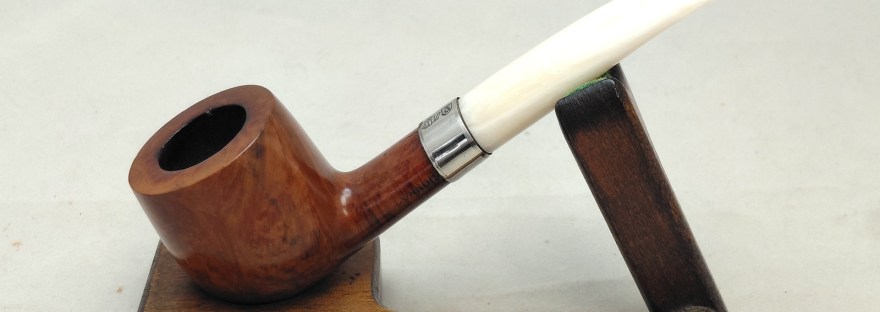
The Connoisseur Pipe Shop in New York City (purchased by Ed Burak in 1968 and closed in 2009) is famous in the pipe community as the home and gallery for Burak’s pipe designs. For more on Burak and the shop, I direct you to this article on Pipedia.org.
I’ve worked on a number of Burak pipes over the years and I’m always impressed by their quality and aesthetics. The Connoisseur pipe on the bench this week is an example of Burak’s more traditional designs, an Oval Shank Pot.
The pipe had clearly been well cared for over it’s history, showing only a touch of rim darkening and one small ding in the inner rim as evidence of regular use. The stem on the pipe was fitted by the pipe’s current steward from a pre-cast stem blank, but it is what I’ll call a “functional” repair in that it fit the shank mortise well and was completely smokeable but didn’t fit the shank quite right, as you’ll see in this initial series of photos.


A close-up inspection starts to unveil the fit issues with the current stem. There is a slight gap between the stem face and shank, and the round stem blank is not wide enough to cover the ends of the oval shank.


Removing the stem reveals a tenon drilled for a 6mm Savinelli filter.

Here you can see that the end of the tenon is somewhat irregular and has a good sized chip out of the edge. This is, according to the pipe’s steward, due to his use of a wood lathe to cut the tenon to size.

Along with the pipe itself, the pipe’s steward also sent me a length of rod stock from which to cut a new stem. As it turned out, this ivory-ish rod is made of resin, which is softer, and therefore easier to work, than Acrylic but won’t oxidize like Ebonite. The salient point here is that the rod is large enough to shape to the entire shank face.

I cut a section of rod a little longer than the existing stem. Some of the excess length would be lost when I faced the rod in the lathe to square up the ends. The rest of the extra length is purely insurance. While I can easily shorten a rod to fit the specs of the stem, it’s much more difficult to make a rod longer if a mistake is made. The remainder of the rod will be returned to the pipe’s steward for future projects.

This pic below shows the rod marked out for drilling the airway. As you can see, this is a multi-step process. I use three drill bits for this job, starting with a 1/8″ bit for the initial drilling to the right-hand mark on the rod.
A tapered 9/64″ bit follows, deepening the airway to the second mark and tapering the end to a fine point. This point acts as a guide for the last drill bit, which puts a 1/16″ bore from the second mark to the end of the rod, completing the airway.

This series of pics shows the process in action. After mounting the rod in my mini metal lathe, I can secure the drill bits in the tailstock and drill out the airway.


Rather than cutting an integral tenon into this stem, I prefer to make up Delrin tenons, especially for filtered pipes. Delrin is incredibly strong even when cut very thin, while still providing a bit of “give” to the tenon. To prep the rod to accept a Delrin tenon, I drilled a 3/8″ mortise into the stem face.

After removing the rod from the lathe, I took these pics of the ends to show the 1/16″ airway through the button end of the stem and the mortise drilled into the stem face where the Delrin tenon will eventually be glued in.


To finish the rough-in work for the new stem, I took the rod to the drill press, where I clamped it upright in a cross-slide vise. After mounting a 1/16″ end mill in the chuck, I lowered the end mill into the airway hole and used the cross slide to cut a neat slot in the button end of the rod. This step provides a guide for the hand files I’ll use later to cut the V-slot in the button end of the stem.

As you can see in this close shot, the proto-slot is a little wonky here and there, but that’s ok. It’s properly centered on the airway, which is most important. I’ll tidy up the slightly wavy lines when I finalize the slot later.

To make the 6mm filter tenon, I mounted a short section of white Delrin rod in the lathe and drilled a preliminary 1/8″ airway through it. The sample filter supplied by the pipe’s steward measured 6.18mm in diameter, so I used a 1/4″ (6.24mm) drill bit to cut the filter pocket in the end of the tenon.
Why white Delrin? Because the stem material is a light colour. Using the standard black Delrin rod could create a shadow under the resin at the tenon end after gluing everything up. Using white Delrin removes that particular risk.


The result is a filter tenon into which the target filter slips easily but securely into.

It was time to size the new tenon to fit properly in the shank mortise. However, I got slightly sidetracked after discovering a hairline crack in the shank. If left alone, this crack would continue to creep down the length of the shank, endangering the structural stability of the stummel. It would also make fitting the tenon properly impossible, as the briar would move every time the tenon was mounted and dismounted from the shank.

With a 6mm filter tenon, there was no room inside the shank for an invisible internal repair, so I drilled a tiny 0.4mm hole at the end of the crack before flowing a bit of thin CA glue into the and over the damaged area. The tiny hole relieves the pressure on the briar, stopping the crack from creeping further up the shank.
I clamped the crack shut tight until the CA glue cured, then gently sanded away the excess glue before fitting a nickel band over the end of the shank.

The band was just a hair oversized for the oval shank, so I secured it in place with some wood glue and left it to dry.

When I came back to the pipe, I made sure there was no excess glue hiding in the mortise, then carefully shaped the tenon to fit snugly, but not too snugly, into the shank.


Once the tenon was properly sized, I remounted the proto-stem in the lathe and used the tailstock and a live centre as a clamp to keep the tenon centred on the airway. A bit of standard two-part epoxy was used to glue the tenon into the stem face.


I left the stem clamped in the lathe overnight to give it enough time for the epoxy to cure completely. When I returned to the shop the next morning, I removed the stem from the lathe and cleaned up the excess epoxy that inevitably gets squeezed into the filter pocket and airway.
A test fit on the stummel showed that the glue-up had worked as planned. The stem sat squarely against the shank face without the gaps that were visible with the original stem.

Now it was time to start shaping the stem. An oval taper stem is an elegant thing when executed properly. In order to maintain the stem’s straight lines and proper orientation to the slot in the button end, I cut 9/64″ strips of masking tape and stuck them to the sides of the rod, centred over the line of the airway. I also marked out the button at the end of the stem.
These guide lines are vital to my stem making process as they provide a visual reference to the location and diameter of the airway running through the middle of the rod, creating a no-fly zone for the tools used to remove the excess material and shape the final stem contours. By keeping the work aligned with the guides, I can also avoid cutting a twist into the stem.

I used a bench-top 1″x30″ belt sander to hog off the bulk of the excess material from the rod, cutting in a rough tapered shape. I usually leave the button area alone at this stage as it’s not vital to shaping the taper and leaves some length on the stem that I can adjust later.


Then it’s away with the power tools and in with the hand tools. I use a variety of files to refine the taper and move the stem closer to its final shape.


Another trick I’ve picked up over the years is to use a slack sanding belt to remove excess material while maintaining the correct curvature on the stem. Even a “flat” saddle stem has a bit of a football shaped cross section to it, multiplied several times over for this Oval Taper profile. The slack belt helps to sand that shape into the round rod while also removing the coarser file marks.


Finer files further refine the stem profile, edging ever closer to that light and elegant look I’m aiming for.


As the final profile begins to emerge from the rod, I cut the button to shape, mimicking the football cross-section of the stem.


This is the point in the process where I like to change gears slightly and cut the V-shaped slot. I used two different slot files and a flat needle file for this work, carefully removing small triangles of rod from each side of the slot to cut the V.

The flat file is really useful for tidying up the slightly wonky edges of the slot. Nice!

There is a significant difference between the stem in the above pics and the stem in the pic below. I’ve spent some time slimming the bite zone in front of the button to between 4.5mm and 5mm thick. This is the range at which the stem becomes comfortable to hold in the teeth without thinning it down so much as to leave the bite zone prone to perforation or other damage. I also refined the button’s height and thickness to make it as comfortable as possible.
When I was happy with the stem, I sanded it from 220-grit through to 2000 grit in preparation for final buffing and polishing. The last thing to do on this restoration is to introduce a small bend to the stem so that the rim of the bowl sits parallel to the ground when the pipe is held in the teeth.

Then it’s off to the buffer for a run on both the Red Tripoli and White Diamond wheels to remove any stray sanding scratches and bring up the shine. A few light coats of Carnauba wax add extra shine and some UV protection for the finished pipe.
This Burak Connoisseur, at first glance, doesn’t appear all that different from when it arrived in the shop but, as the saying goes, the devil is in the details! The new Hand Cut stem fits the shank properly, from edge to edge to edge of the oval shank, and sits flat against the shank face. The Delrin 6mm filter tenon is much more damage resistant that the integral tenon in the old stem, and fits the desired filters well.
The nickel shank band was installed out of necessity to shore up the cracked shank, and though it covers the stamps a bit, the band adds a certain richness to the pipe’s overall look. Who doesn’t like a touch of bling?
The finished pipe is ready to be put back into its steward’s rack and rotation, where it should serve faithfully for many years to come.
I hope you’ve enjoyed watching this Hand Cut resin stem take shape. Hand Cut stems are a lot of work, but they are one of a kind custom creations for cherished pipes and the only way forward when suitable precast stem blanks are unavailable. As a bonus, Hand Cut stems can be made exactly as one wishes without the restrictions precast stems might present regarding size, shape and colour. The sky’s the limit!
Until next time, Happy Piping! Here’s the finished pipe.


 dadspipes.com