
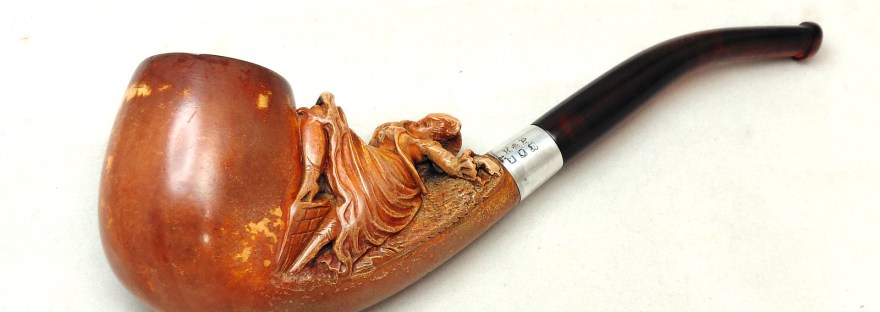
Amber has been prized for its beauty and workability for thousands of years. Used in the creation of jewelry, trade goods and once believed to have magical and medicinal properties, Amber also made its way into the pipe making world as a stem material.
Unfortunately, Amber, while beautiful to look at, isn’t a really good choice for a pipe stem due to its fragility, relative softness and its susceptibility to crazing, cracking and other damage. Only a small percentage of Amber pipe stems have survived intact, most notably on high-end, collectible Meerschaum pipes.
Fortunately, there are modern alternatives to genuine Amber pipe stems, which is great news for the pipe on the bench this week. This intricately carved K&P meerschaum stummel features what appears to be a Victorian dancing girl reclining in the crook between bowl and shank. A Sterling Silver band shores up a delicate shank with the original bone screw tenon still intact. The original Amber stem, however, is long gone.


The Sterling shank band is stamped “K&P” over a trio of hallmarks – Hibernia, Harp and a date letter, “i”. As the “K&P” stamp identifies the maker as Kapp & Peterson, a quick look at the Dublin silver hallmark reference page tells us that this pipe was made in 1924.

This pipe is in the care of an ardent Peterson collector who wished to have the piece restored for display, retaining as many of the original features of the pipe as possible. To that end, my brief for this job was clean and wax the meerschaum stummel, craft a new stem from Red Amber Acrylic rod in a period-correct round button style that mounted to the shank using the original bone screw tenon.
To get the ball rolling on the project, I dug through my supplies for a sample stem to ct as a template of sorts for determining the length of the new Acrylic stem. The Vulcanite stem blank shown below looks about right.

After a quick measurement, I cut a section of Red Amber Acrylic rod to length, leaving myself a bit of wiggle room for final adjustments. Then the Vulcanite stem went back in its bin and I turned my attention to the stummel.

While the internals of the stummel were quite clean already, the exterior of the meerschaum was not. I scrubbed the stummel gently with a toothbrush dipped lightly in clean water to loosen and remove the dust, dirt and grime from the delicately carved meerschaum. This revealed much more of the details than were previously visible .


Setting the stummel aside to dry, I moved back to the new stem. After mounting the section of Acrylic rod in the lathe, I drilled an airway through the rod that tapers from 9/64″ at the tenon end to 1/16″ at the button end.
This is done using three separate drill bits – a 1/8″ bit for the first drilling, followed by a 9/64″ taper-point bit and finally a 1/16″ drill bit to cut the final bore from the end of the tapered airway through the end of the rod.
As this stem would be connecting to the stummel’s original bone screw tenon, I followed the airway drilling by cutting a 6mm mortise into the tenon end. This mortise was then tapped for M7x1 threads.


A quick test fit told me that my drilling and tapping had been successful. The Acrylic rod looks a bit silly mounted to the shank at this point, but I needed the threaded mortise verified before moving forward.

This next pic shows the new stem turned down to just over final diameter. The button end is oversized and bulky at this point, but the important thing to note here are the lines of masking tape running down each side of the proto-stem.
The tape, cut to 9/64″ wide, provide visual references for the location and width of the airway drilling through the centre of the rod. These reference lines are vital for keeping the planned vintage football shaped button properly oriented to the shank when the stem is mounted on the threaded tenon.

With all my reference lines in place, I took the stem to the belt sander for the first rough shaping. A 220-grit belt makes short work of removing the excess Acrylic, though this process does generate a LOT of fine Acrylic dust, so proper dust collection at the tool and an N95-rated respirator are highly recommended to avoid breathing in the airborne particles.

After cutting the initial taper in the rod stock, I switched from power tools to hand tools to complete the new stem. Beginning with coarse files, I began the process of smoothing and refining the shape of the new stem.


I find a slack line helpful when sanding a rounded profile. In these pics, I’ve clamped a 1″x30″ sanding belt to my work table. The other end is held in place between my knees with a long dowel. This arrangement lets me sand the curved profile on each side of the stem with a fair degree of control.


When I was close to final dimensions on the body of the stem, I removed the excess Acrylic from the button area and began to shape a “fat football” shaped button using files and sandpapers.


Larger files were replaced by smaller, finer files to further refine the shape of the button and the contours of the stem.

Finally, I sanded the stem with 200 through 2000 grit sandpapers to remove the file marks and prepare the Acrylic for final buffing and polishing.

The new stem was now looking great, but the stummel needed a bit of love too, so I brought my wax pot up to temperature to melt the beeswax kept inside it. When the wax was liquified, I corked the bowl and shank openings to keep the wax out of the chamber and airway, then submerged the meerschaum in the hot wax.
Meerschaum is a porous material that acts as a sump for water and tars released by the burning tobacco during a smoke. The tarry liquid is absorbed by the meerschaum, creating the signature cooler, drier smoke meerschaum pipes are known for.
The same porosity helps the meerschaum achieve its trademark dark amber-brown colouration. Submerged in the hot beeswax, the meerschaum soaks up the wax, which reliquefies the tars trapped inside the fabric of the stummel. Capillary action then draws the colour to the surface of the meerschaum, as seen quite dramatically in the pic below.
I let the stummel soak in the wax, turning it over periodically, until it stopped changing colour. This indicated that the meerschaum had absorbed all the wax it could hold and it was time to remove the stummel from the wax pot.
I set it carefully on a clean towel to cool. When the stummel was cool enough to handle, I removed the corks and hand buffed the meerschaum with the towel to remove the excess wax from the surface and bring up the shine.

I let the stummel cool completely before mounting the new stem and taking the pipe to the buffer to polish up the Acrylic. A run on both the Red Tripoli and White Diamond wheels erased any stray sanding scratches and gave the Acrylic a glass-like shine.
The finished pipe looks like a completely different piece from the dusty and grimy stummel that arrived in the shop. The meerschaum is clean and fresh and looks every inch the 102-year-old collector’s piece, its rich red-brown colour complimented by the vintage style Red Amber Acrylic stem. Though destined for display as part of its new steward’s collection, this Meerschaum is completely functional and could be (carefully) smoked should the mood strike.
I hope you enjoyed watching this vintage pipe come back to life over the course of the restoration. Most pipes don’t survive ten decades of use to become collectibles. I’m proud to have played a small role in the preservation of this handsome 1924 K&P Bent Billiard.
Until next time, Happy Piping! Here’s the finished pipe.


 dadspipes.com
Thanks for the shout-out, Mark!
LikeLike