
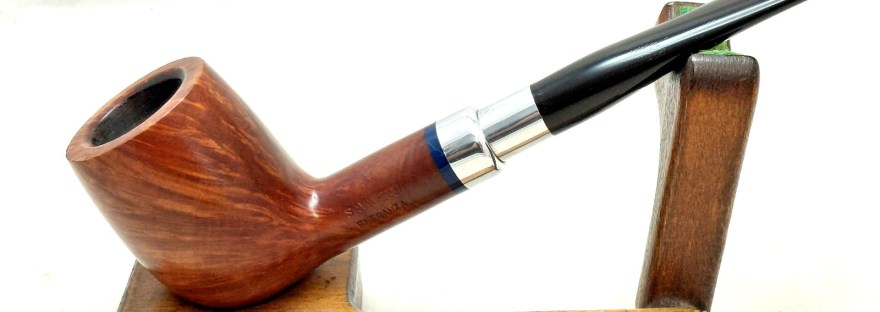
As any long term reader of this blog can tell you, the stem tenon is the number one weak spot on any pipe. The tenon is the smallest component, and has an airway drilled through it, further compounding its fragility. Add a 6mm or 9mm filter pocket in the tenon and the tenon walls get considerably thinner than a non-filtered tenon with a standard 3mm airway.
The owner of this lovely Savinelli Eleganza 111KS Billiard learned this lesson the hard way when an accidental drop snapped the 6mm tenon off the Acrylic stem.
I’ve replaced hundreds, if not thousands, of tenons over the last 10+ years of pipe repair and restoration. It’s a “bread & butter” repair for any pipe shop and becomes fairly routine after the first few dozen. This repair, however, would be somewhat more challenging as there was also a Faux Spigot fitting to contend with.
This initial series of images shows the pipe as it looked on arrival at the shop. The pipe was obviously well care for by its steward. The briar was clean, the chamber carried only a light layer of carbon cake and, apart from the broken stem, the pipe showed no other signs of damage. I gave the stummel a quick cleaning to make sure the shank mortise didn’t have any surprises lurking within, then focussed my attention on the challenge of recreating the broken stem.


The pipe is stamped on the left chank with “Savinelli” over “Eleganza”, and on the right shank with a shape code, “111KS”, indicating a Straight Billiard, King Size. The shank is also marked with “Made in Italy” on the underside of the shank but I failed to get a good picture of that. You may spot the stamp peeking out in a few other images below, though.


So what exactly is a Faux Spigot pipe? The easy answer is that it is a pipe designed to look like a true Spigot system, which features a metal shank cap and a metal sheath over the stem tenon, but fits together with a standard push tenon instead of a friction-fit Army Mount.
Here is a close shot of the end of the pipe’s shank. You can see that the nickel shank cap surrounds a cylindrical mortise into which a push tenon fits to mount the stem to the shank.

And here is a close shot of the broken stem. The blue Acrylic stem is drilled to accept a Delrin 6mm filter holder/tenon, and the nickel band is installed over both, acting as both a bit of bling and some structural reinforcement for the join between the Delrin and Acrylic parts.
The break occurred just behind the nickel band, at the end of the Delrin tenon where the Acrylic is thinnest.

Here’s a pic of the broken end of the tenon section – note how very thin the blue Acrylic is here at no more than 1mm.

A look at the broken end of the stem itself also shows how very delicate this stem really was. The thin ridge visible running around the circumference of the filter pocket is the remnant of the Acrylic walls holding the filter tenon in place. In my mind, the nickel Faux Spigot band should have extended further down the stem body to overlap this weak point.

The pipe’s steward had asked me for several things: to craft a new Vulcanite stem that preserved the Faux Spigot fitting; to include a 6mm filter tenon, and to make the new stem 1cm longer than the original. My first task, then, was to salvage the nickel band from the original stem in order to transplant it onto the new stem.
I accompished this by the simple expedient of warming the tenon and the nickel band over the heat gun until the glue holding the band in place let go. I could then carefully twist the band of the end of the broken tenon.

Unlike the original two-part stem, I planned to craft the new stem in a single piece. To that end, I selected a Vulcanite stem blank from my supplies that was roughly 1cm longer than the original and had a molded tenon larger than the finished diameter of the required 6mm filter tenon.
This pic shows the nickel band above the new stem blank and the original stem.

Pipe filters come in basically two nominal sizes – 9mm and 6mm. Note that this doesn’t mean the filters are ACTUALLY 9mm or 6mm in diameter, nor are two filters from different manufacturers guaranteed to be the same diameter or length. For example, a nominally 9mm filter can, in fact, range between 8.7mm and 9.2mm in diameter. This is why I always request that the pipe steward include a sample filter with the pipe to ensure that the filter pocket is drilled to the correct depth and diameter for the target filter.
In this case, the pipe’s steward had sent a Savinelli 6mm cartridge filter with the pipe, so after a bit of measuring, my first operation on the new stem blank was to enlarge the stock airway to fit the supplied filter. A bit of tape on the drill bit acted as a depth stop.

With the filter pocket dealt with, I mounted the stem blank in the lathe for the next few operations. All in, I’d need to carefully cut short sections of tenon to four different diameters – a larger section close to the final size of the finished stem, a section slightly smaller onto which the nickel Faux Spigot band would fit, a section for the tenon proper that would hold the stem into the pipe’s shank, and a smaller step-down section at the end of the tenon that fits into the junction of the shank mortise and shank airway proper.
These pics show the steps, beginning with the rough sizing of the required length of Vulcanite.

This little step-down cut is the finished stem diameter just behind the nickel band. Cutting a few millimetres like this now allows me to keep the files safely away from the nickel fitting later.

Here is the nickel band dry-fit to the tenon. Looking good!

And finally, here is a pic of the stem with all four sections cut to diameter.

A dry fit to the shank confirmed that all was well within acceptable tolerances. If something had been off at this stage, I’d have needed to start over with a new stem blank.


Here you can see the Faux Spigot stem taking shape. I still need to do quite bit of work to the stem blank behind the nickel band, but the fiddly bits are done!

A few drops of CA glue secured the nickel band to the new stem.

And then it was back to the lathe to begin removing the excess Vulcanite from behind the band. I do this sort of work with hand tools on the lathe for better control cutting tapers and curves.

When the bulk of the excess material had been removed on the lathe, I remove the stem from the tool and switched to manual work with first coarse, then finer, files to refine the stem’s shape. The masking tape over the Faux Spigot fitting helped protect the metalwork from stray file strokes.


When I was happy with the overall size and shape of the new stem, I put away the files and moved to sandpapers in 220 through 2000-grit to erase the file marks and begin to bring up the shine.
After wet-sanding with 2000-grit paper, I took the stem to the buffing wheels for a final polishing on the Red Tripoli and White Diamond wheels. A few coats of Carnauba wax added more shine and a layer of UV protection for the Vulcanite. The stummel also received a quick buffing and waxing to ensure that the whole pipe looked its best when it was returned to its steward.
The finished pipe looks great, in my opinion. The Faux Spigot fittings line up as they should, without gaps or other distractions from the illusion. The new Vulcanite stem looks like it has always been a part of this pipe, tapering gracefully from the nickel band to the button. As you’ll see below, a Savinelli 6mm cartridge filter fits snugly, but not too snugly, in the filter tenon and protrudes just enough to allow for easy removal and replacement. I’d call this one a win by any standard!
I hope you enjoyed following along on this somewhat unique repair which blended structural work with client customization and required a bit of ad hoc reverse engineering of the original factory stem. I learned quite a bit throughout this repair; I hope you did too.
Until next time, Happy Piping! Here’s the finished pipe.


 dadspipes.com