
Shank cracks are a common part of pipe repair, but there are situations where a standard external shank band just doesn’t work – a tapered shank, for instance – or when, for aesthetic reasons, the pipe’s steward doesn’t want to change the outward appearance of the pipe. What to do then?
This is where the internal shank repair, or shank sleeve, comes into its own. As the name suggests, the repair happens inside the shank where no one can see it without removing the stem.
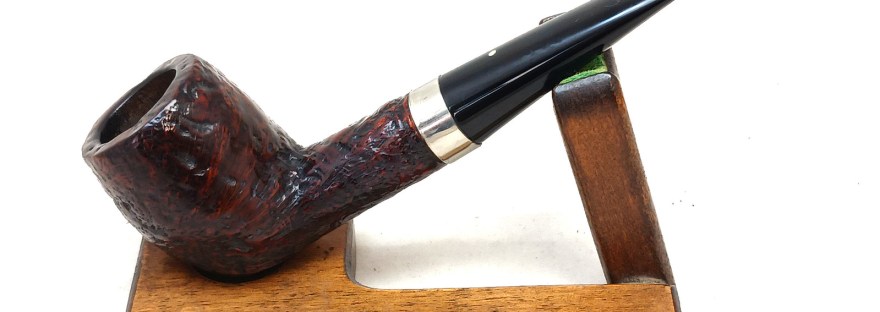
The pipe I’ve chosen to use for this tutorial post is a1960s Dunhill LB Shell Briar. The LB shape is a Dunhill classic, a Large Billiard, with chunkier proportions than a Standard Billiard of the marque. This particular LB was, I suspect, someone’s favourite, as it had clearly had some work done, notably a shank band that had presumably been added to correct a crack in the mortise wall. Curiously, the repairer made no effort to rectify the crack spiralling around the shank about a centimetre behind the shank band. That repair is the focus of this post.
This image shows the pipe as it looked when it first arrived on the bench. Besides wanting a good reaming and cleaning, the pipe had a few obvious deficiencies – the stem would not seat fully in the shank and showed tooth damage on both the upper and lower bite zone surfaces behind the button. The rim of the pipe was clear of carbon “lava” buildup, but the sandblast finish looked somehow softened and appeared slightly worn down.

At first glance, it’s easy to assume that all the pipe needed was a good cleaning and polishing, but have a look at these close-up shots of the pipe’s shank after being cleaned.

Circled (rather poorly) in red is a long crack that starts at the shank face under the band and spirals down and around the shank, running through the “Made in England” stamp, nearly obliterating the all-important Dunhill date code. It was still legible, if barely. Decoding the stamps tells us that this Dunhill LB was made in 1961.
Circled in orange is another oddity. The more I looked at this pipe, the more I was convinced that the earlier shank repair was done by someone not quite sure of their own skills. My guess here is that the available shank band was slightly too small, but instead of sourcing a larger shank band, the person who did this earlier repair reduced the diameter of the shank. Unfortunately, they somehow managed to take all the extra briar off one side of the shank, creating this lopsided appearance.
To be clear, I’m not arguing against the use of a shank band here. There was definitely a crack in the briar at the mortise, but this old repair is the equivalent of sticking one’s finger in the proverbial dyke to hold back the incoming sea. As far as I could tell, the long crack wasn’t even glued, leaving the shank at real risk of snapping off.
For readers who have not seen an internal shank repair, the process is not overly complicated but can go sideways at a few points along the way. The shank mortise is first drilled out to enlarge both its diameter and depth, then a tube of briar is glued into the shank, bridging the crack and restoring the structural integrity of the shank. The stem tenon then needs to be resized to fit inside the sleeve.
It’s important to note here that the shank needs to have enough real estate to allow the mortise to be enlarged while leaving enough room inside the shank for a smaller tenon. Not every pipe fits the bill – the shank on a Savinelli Bing’s Favorite, for instance, is just too small for this kind of repair.
I didn’t have to worry about insufficient space inside the shank with this Dunhill LB. This pic shows the shank mortise enlarged to 10mm diameter and drilled about 5mm beyond the furthest reach of the crack.

This is the first potential failure point in the repair process. If the shank is very compromised by the crack, it may not hold together under the torque of a drill bit. If the shank breaks during drilling, you’ve made some extra work for yourself, but it’s usually recoverable in all but the most dire situations.
The second potential failure point in the shank drilling is misalignment. It’s quite easy (and sadly, common) to have the drill bit wander slightly when enlarging the mortise. A variation of just fractions of a millimetre can throw the shank/stem geometry off, but again, this is a recoverable issue, as you’ll see a little bit later.
I can see two potential cracks in the end of the shank under the shank band – one at the 5 o’clock position and a second at the 10 o’clock position. This second crack likely joins up with the spiral fracture I’m trying to fix.

With the drilling safely accomplished, I took a few careful measurements of the new shank mortise, then fit a piece of new briar into the lathe and turned it to diameter before drilling all the way through to create our splint, essentially a briar tube.


A dry fit of the splint in the shank showed where I needed to make a few small adjustments, mainly to its length.

When I was happy with the dry fit, I mixed up a bit of standard two-part epoxy, applied some of it to both the inside walls of the mortise and the outside of the splint, then slid the splint home.

After wiping away the inevitable squeeze-out of excess adhesive, the splint looked great, filling the mortise from the bottom all the way to the beginning of the counter-sunk area at the end. Once the epoxy fully cured, the shank would be permanently repaired without any visible alteration to the exterior of the pipe. I like epoxy for these jobs as it makes a strong, permanent bond, but wood glue would also be appropriate here if you prefer.
Here is the next potential failure point in the repair process. While it’s necessary to size the splint to allow room for the adhesive, you don’t want to remove too much material. A sloppy fit opens the door to major issues with misalignment that you may not be able to easily come back from.

I set the stummel aside overnight to give the epoxy time to cure. When I came back to the pipe, I completed the cleaning by reaming the chamber of all the old cake, then scrubbing the exterior of the briar with Murphy’s Oil Soap and a toothbrush. This lifted away a surprising amount of dust, dirt and old wax.


I had to include these pics of the stummel after the Murphy’s scrub. If you compare the briar before and after, you can see just how much detail was lost under the layers of grime and wax.


The cleaning also made the shank crack much more obvious. Now you understand why I wanted to get the shank splinted before doing anything else.


With the splint glued into the shank, the stummel was now structurally sound but needed some cosmetic repairs. To fill the crack and push the damage into the background visually, I flowed CA glue into and over the damaged areas. If the crack had been more open, I would have used a mixture of briar dust and CA glue, but in this case the glue would do just fine without the filler.
While the CA glue was setting, I worked on re-fitting the stem. I first attempted to simply reduce the original tenon to fit the new shank mortise, but that resulted in a small sliver of a gap between the stem and shank (remember all that talk about tiny misalignments causing problems?). Rather that spend time futzing around, I chose to cut off the original tenon and install a new shop-made Delrin tenon.
I’m not simply taking the easy way out here. I’m taking a route that guarantees a light-tight fit of stem to shank when all is said and done. Removing the original tenon and installing a new tenon provides the opportunity to compensate for minor misalignment of the shank mortise.
This pic shows the short section of Delrin rod mounted in the lathe chuck. The rod has been turned to diameter, drilled for an airway and the end has been countersunk to help smooth out any turbulence as the smoke flows through the shank/stem junction.

A test fit of the tenon into the shank of the pipe confirmed the fit – snug but not too snug.

Before I glued the tenon into the stem, I spent a bit of time on the cosmetics of the shank. The CA glue I had applied earlier had hardened but I couldn’t leave the glue splotched onto and over the briar. I used a variety of tools to remove the excess glue and texture the repair to blend into the sandblast finish of the Shell Briar.

A small carving burr mounted in my rotary tool smoothed out the lump of briar on the side of the shank. I didn’t remove much material at all, but it made a huge difference visually.


The crack still cuts through the stamps on the bottom of the shank – there’s nothing to be done about that, unfortunately. I worked carefully to remove the excess CA glue without damaging the nomenclature.

When I was happy with the look of the shank, I blended the repair into the original finish using a couple of stain pens. I went with the stain pens because the repaired areas is small and contained. If the damage had spread to more briar, I might have considered refinishing the entire stummel.

A wipe of mineral oil over the briar helped to set the new stain and inject some much needed moisture.

Finally, I was ready to install the stem. After cutting off the original tenon, I faced the stem on the topping board, sanding it flat and square to the airway.


I drilled out the airway at the stem face to create a mortise for the tenon to slide into. This is yet another potential failure point. Drilling an overly large mortise in the stem face creates multiple issues – visible glue after the repair is complete, and a greater risk of the tenon pulling out of the stem down the road. I aim for a mortise that is only about two to three 100ths of a millimetre larger than the tenon. This provides just enough room for epoxy and a touch of wiggle room for aligning the stem flat against the shank face.
After a quick dry fit, I roughed up the end of the tenon to give the adhesive something to grip onto, then glued the stem up using a bit of JB Kwik-Weld epoxy.


As is my usual method, after applying epoxy and fitting the two halves of the pipe together, I clamped the pipe upright in a padded vise to allow gravity to assist in keeping the stem tight against the shank face. A wrap of tape kept everything lined up while the epoxy cured overnight.

When I came back to the pipe, I twisted the stem out of the shank and chased the airway with a drill bit to clear out the excess epoxy. After re-mounting the stem, I sanded the Vulcanite to remove a light layer of oxidation and smooth out as many of the dents and dings as I could. The results were not perfect, but the best available to me given the thickness of the Vulcanite at the button. When thinning a stem to remove damage, there is a line beyond which one dare not pass if one hopes to retain the stem’s integrity in the bite zone.

To finish off this restoration and this tutorial, I took the complete pipe to the buffers for a run on the Red Tripoli and White Diamond wheels to smooth away the last of the sanding scratches and bring up the shine. A few light coats of Carnauba wax added more shine and a layer of UV protection for the restored stem. I took care here not to obliterate the details of the sandblast finish by applying too much wax to the stummel.
The finished pipe is once again looking like a classic Dunhill that any pipe lover would be pleased to add to his rack and rotation. Gone are the dirt and grime that once filled the nooks and crannies of the Shell briar finish, and, better still, the shank is structurally sound. The pipe is looking as close to factory fresh as possible, thanks to the invisible internal shank sleeve.
This lovely 1961 Dunhill LB has been returned to its steward, where I expect it will serve well and faithfully for at least another 64 years, given a modicum of care and maintenance along the way.
Thanks for joining me for another estate pipe restoration. I hope you enjoyed the tutorial style. If you’d like to see more pipe repair tutorials, please comment below.
Until next time, Happy Piping! Here’s the finished pipe.


 dadspipes.com
Wow, amazing technical work. I don’t think many pipe repairmen can pull off this kind of repair.
LikeLiked by 1 person
Thanks very much! This is definitely one repair that relies on a dialed in lathe, And my apologies on the very late reply – my website notifications weren’t making it through for a bit there. Fixed now!
LikeLike
Great repair…
LikeLiked by 1 person