
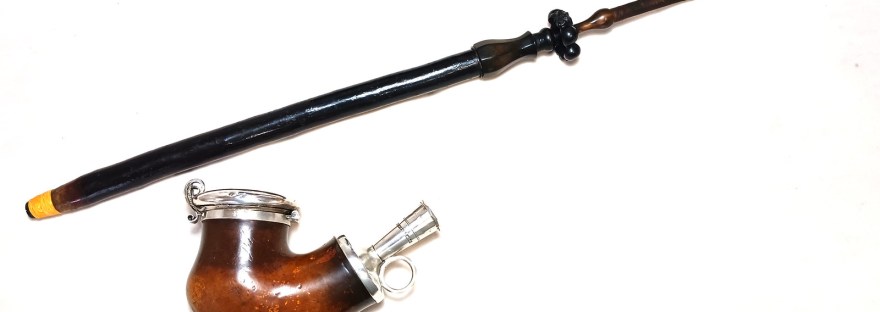
Welcome to Part II of the repair and restoration of an 1850 Long Pipe! Last time, we covered the work completed on the pipe’s long Cherrywood shank and unique Ebonite mouthpiece with a flexible leather-wrapped shaft. We also hand cut a new Ebonite bit to replace the original that had been broken short at some time in the pipe’s 175 year history. Here is a quick pictorial refresher of the restoration of this “half” of the pipe before and after the work.


This week, I’ll be focussing on the cleaning and restoration of the large meerschaum and silver stummel. As a reminder, here is what the stummel looked like when it came into the shop – dirty, greasy in the hand, with a host of small scratches and handling marks. The silver wind cap and shank volute were tarnished nearly black.


The silver rim cap carries four stamps – “13-1/4”, “1850”, “Prove” and “MÖ”. The 1850 stamp indicates the year the silverwork was assayed. “13-1/4” refers to the purity of the silver and means “13-1/4 parts out of 16”, or about .828 purity. My research tells me that mark was used in Denmark and Finland for a short time in the mid 1800s.
The last two marks are more of a mystery. I haven’t been able to find any information on the “Prove” mark, and the “MÖ” stamp, presumably the maker’s mark, is not included in any of the usual online silver hallmark databases.

The silver shank volute was really heavily tarnished and quite dirty, with grime packed into and obscuring the silver marks.


After a preliminary scrub with 0000 steel wool and a damp toothbrush, the stamps became much more legible. They read “Östgaard”, “Prove”, “Drammen” and “1850”. Östgaard is a small Norwegian village just north of the Swedish border, while Drammen is a historically important port and river city southwest of Olso, Norway, so I think we can reasonably conclude that this antique long pipe is of Norwegian origin.


I also found the “13-1/4” and “MÖ” stamped on the underside of the silver wind cap.

So how could a Danish silver purity mark fit with not one but two locations in Norway? Historically, there are strong connections between the two countries. In the Viking era, present day Norway, Sweden and Denmark were united under the Danish Crown, but eventually divided into their own sovereign states.
During the 1850s, the period in which this pipe was made, Norway was in a “personal union” with Sweden, only declaring independence in 1905. This somewhat turbulent political history, with its shifting borders and regulations appears to have left gaps in the historical hallmark records, making the tracing of this piece’s history rather difficult.
With about as much of the pipe’s history set down as I could gather, I moved on to the work at hand. The silver fittings were really in a bad state, but given their proximity to the meerschaum body of the pipe, needed to be cleaned with care. Instead of using a commercially available silver cleaner, I opted for a simple paste of baking soda and water to scrub the silver clean of its layers of grease, wax and tarnish. The meerschaum was gently cleaned with a toothbrush dampened in clean water before hand buffing with a soft towel.

I used a combination of a toothbrush, 0000 steel wool, Magic Eraser and several sizes of cotton swabs to clean the nooks and crannies of the silverwork, rinsing periodically with fresh water to judge my progress. This was a messy and time consuming task, but the results were well worth the trouble.


With the exterior of the pipe clean, I switched focus to the internals of the stummel. The chamber of this pipe was reasonably free of carbon cake, so a quick dressing off with sandpaper wrapped around a dowel was all it required. The shank and airway took a bit more work, this time using pipe cleaners dipped in 99% isopropyl alcohol to clear the tars and debris. Fortunately, the airway through the shank was drilled in a single straight shot from shank to bowl, enabling a pipe cleaner to pass smoothly from end to end.

The final task of this marathon restoration was to wax the meerschaum stummel with fresh melted beeswax. This is done when meerschaum pipes are first carved, and should be repeated periodically to both maintain the appearance of the meerschaum and to draw out the sought-after colouration for which meerschaum pipes are famous.
I prefer to wax meerschaum stummels by immersion in melted beeswax, but this stummel was far too large to fit in my wax pot and there was no practical way to plug the bowl and shank even if it could fit in the pot. Instead, I melted the beeswax with my heat gun, and after warming the meerschaum as well, I mopped the hot wax onto the stummel.
The meerschaum had obviously not been waxed for some time as it readily absorbed the beeswax mopped onto the surface, leaving dull patches in the finish. I continued to heat the meerschaum and mop on more melted wax, turning the stummel regularly to ensure even distribution, for close to an hour before the meerschaum had absorbed all that it could. The process was a bit tedious, to be fair, but I always find it fascinating to watch the white meerschaum turn to dark amber brown.

I set the stummel on a soft surface to cool enough to handle comfortably, then hand buffed the excess wax from the surface with a clean microfibre towel. The finished stummel is a much more even colour across its surface, and has a lovely warm sheen and the gentle scent of honey.

Finally, it was time to bring this project to a close. To provide a secure fit between shank and stummel, I wrapped the tapered end of the Cherrywood shank with waxed hemp.

I could then assemble the finished pipe and take one final set of pictures. The assembled pipe was far too long to fit in my small lightbox, so I snapped a complete pic on the benchtop and took the rest of the shots with the pipe disassembled.
I hope you’ve enjoyed following along with this rather special restoration. I don’t often get the opportunity to work on truly museum-quality pipes, and this 175 year old Norwegian Long Pipe from 1850 was both a challenging and rewarding project. Now clean, polished and made whole, the pipe’s steward can display it proudly and enjoy a very retro smoking session as desired.
Until next time, Happy Piping! Here’s the finished pipe.


Wow… beautiful work and the colors look really nice. Makes me want to get a Meerschaum… but I don’t have 175 years to watch it change.
Thank you for sharing Charles…
Blessings,
Rick
LikeLiked by 1 person
PS… I am just guessing… but I assume the lid on the pipe is to just keep the tobacco from spilling while these gents went about their daily routines…
Or could they actually still smoke the pipes with the lid down?
Thanks again for sharing..
Rick
LikeLiked by 1 person
Hi Rick. The bowl cap is actually vented under the rim, so the pipe can be smoked with the lid down. Useful as a wind cap for smoking outside but I’d guess this pipe was smoked mostly indoors – it’s not particularly portable at almost 3 feet long. 🙂
LikeLiked by 1 person
Sounds more like a team smoke…
3 feet long… Wow…👍
LikeLiked by 1 person