
After a decade in the business, some pipe repairs and restorations have become routine, but every now and then a project arrives at the shop that is anything but ordinary. I love these projects as they often require outside-the-box solutions for unique challenges, involving methods and materials usually not found in more standard restoration work.
The pipe on the table this time is one such project. Sent in by a fellow Canadian pipe lover, this restoration took time, patience and some creative thinking to execute, so much so, in fact, that I’ve decided to spread the full process over two blog posts. In this first post, I’ll lay out the condition issues the pipe arrived with and cover the cleaning and restoration of the pipe’s unique shank and mouthpiece. In Part II, we’ll look at the restoration of the silver-mounted meerschaum stummel.
But before we get started, I think it’s important to clarify the meaning of the term “long pipe”. Differing from a standard Churchwarden pipe, which is essentially come to indicate a standard stummel with an elongated stem, a Long Pipe, in the European tradition, is made up of a stummel, with or without wind cap and shank detail, a long, removable shank and a mouthpiece in the Bavarian style – round in profile and often with several “buttons” or flared details along its length. Long pipes can range from rather simple constructions using briar, clay or porcelain bowls, Cherrywood shanks and simple fittings to elaborately carved showpieces of meerschaum, ivory, silver and other luxury materials.
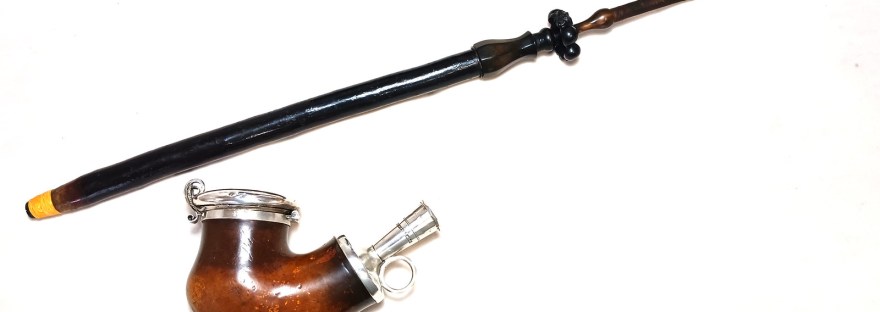
The pipe on the bench this week falls somewhere in the middle of the “posh pipe” spectrum. The stummel is a hefty piece of block meerschaum, carved in a fairly simple shape, dressed up with Silver wind cap and shank fittings. The long shank is Cherrywood – not much more than a Cherry branch with an airway drilled through it – but the mouthpiece is artfully carved from Ebonite and features a unique flexible shaft that allowed the smoker to bend the mouthpiece to a comfortable smoking angle.
From the front of the bowl to the end of the mouthpiece, this pipe stretches nearly 36″ across the workbench. The smoker would, by necessity, have had to rest the stummel on his knee or perhaps a small footstool in order to enjoy this pipe comfortably. It’s definitely not for use on the go!

The stummel alone measures slightly over six inches in length, including the silver volute on the shank, and about four inches tall, including the silver wind cap and weighs about a pound and a half.

The entire piece was quite dirty, with many small scratches on both the meerschaum and silver. Every piece of this long pipe would need a solid cleaning followed by a sensitive restoration.


The silver rim of the bowl is stamped, from the 12 o’clock position and moving clockwise, with “13-1/4”, “1850”, “Prove” and “MÖ”. The 1850 stamp is fairly straightforward, indicating the year the silverwork was assayed. “13-1/4” refers to the purity of the silver and means “13-1/4 parts out of 16”, or about .828 purity. This mark was used in Denmark and Finland for a short time in the mid 1800s.
The last two marks are more of a mystery. I haven’t been able to find any information on the “Prove” mark, and the “MÖ”, presumably the maker’s mark, is not included in any of the usual online silver hallmark databases.

The silver shank volute also carries the “1850” and “Prove” marks, but adds two other stamps that would take some cleaning up to be read.


Now that you’re squinting hard at the illegible hallmarks, I’ll leave that aspect of the investigation for Part II of this restoration and move on to the shank and mouthpiece. As mentioned, the shank is a simple Cherrywood branch, tapered at the stummel end to friction fit inside the silver volute, and threaded on the mouthpiece end to accept the first Ebonite fitting.

This close shot shows the details of that fitting, which is actually made up of two pieces, the fluted section and the rosette, which fit together with rather delicate threads.

This pic shows the pipe almost fully disassembled, with shank, fluted fitting and rosette, the stummel itself and the rather unique flexible mouthpiece.

These closeup shots of the mouthpiece shows how it was made, with Ebonite fittings at both ends and a coil of steel wire wrapped in leather in the centre. The delicate bit, the “business end” of the mouthpiece, had been broken off at some point in the pipe’s 175 year history.


There was quite a lot on the hit list for this restoration project – cleaning every inch of the pipe to remove years of dirt, grime and grease, polishing decades of tarnish from the silver fittings, cutting a new Ebonite bit to replace the broken original, and restoring the leather wrapped flexible mouthpiece.
I started this epic adventure by giving the original Ebonite parts a good cleaning. These pics show the shank fitting and rosette separated and then reassembled after cleaning out the accumulated tars and dirt using 99% isopropyl alcohol and cotton swabs. The exterior of the parts received a good scrubbing with Murphy’s Oil Soap and a toothbrush to sweep the dust and other accumulations from the carvings.


In order to repair and restore the flexible mouthpiece, I first needed to carefully disassemble it into its component parts. I used a fresh razor blade to first cut away the remnants of the dry, crispy leather wrappings from the inner coil, after which I could separate the coil from the Ebonite fittings. The plan was to repair and reuse the short Ebonite fitting that screws into the centre of the rosette, but replace the broken mouthpiece with a new hand cut Ebonite reproduction.
These pics show the end piece after removing the coil. As the close shot shows, the coil end of the part was threaded, providing some mechanical reinforcement to the glue used to hold the coil in place.


After quite a bit of fiddly work, I successfully removed the coil from both end fittings. It had been distorted over time, so I used a length of metal rod as a template to reshape the coil into a more cylindrical arrangement.

The broken original bit was measured up to use as a template for cutting a new piece of Ebonite. Based on these measurements, I turned a section of Ebonite rod to rough diameter, then drilled a 1/8 inch airway through the centre of the rod. While the rod was still full sized, I drilled and tapped a mortise into the end to match that of the original bit.
This pic shows the rod mounted in the lathe and marked out for a series of 3 smaller “buttons” along the length of the part and one larger “true” button at the righthand end of the bit. The end clamped in the lathe chuck is the mortised end, where the restored flexible shaft would eventually mount.

After a bit of work with various cutting tools, the bit was taking shape!

This pic shows the new bit over the original. The mortise end of the bit still needs some shaping to remove the hard lines, and I have deliberately left is slightly larger in diameter in the hopes of avoiding another breakage.

And here is the almost finished bit after shaping the flared end and sanding to 2000-grit.

I set the new Ebonite bit aside at this point to focus on repairing the original fitting at the other end of the flexible shaft. It had developed a short crack in one spot, which I repaired with CA glue. The small spring clamp helped to close the crack somewhat during the repair.

I let the CA glue cure completely, before sanding the repair smooth. The sanding removed a darkened outer layer of the old Ebonite, revealing a faux horn pattern underneath!

I followed suit with the rest of the original mouthpiece parts, bringing out a touch of the original colouring on all three.

Cleaning the Cherrywood shank was fairly straightforward, using pipe cleaners and alcohol inside the airway and Murphy’s Oil Soap on the exterior to lift away a surprising amount of grime from the surface. The Ebonite parts were then buffed and waxed on the wheel, while the shank was also treated a protective layer of Carnauba wax. This pic shows the cleaned and repaired parts.

During all of the work to this point, I had been mulling over the best approach to restoring the flexible centre section of this nearly 10 inch long mouthpiece. After some consultation with the pipe’s steward, it was decided to add a bit of insurance to the mix by first sealing the steel coil in electrical shrink tubing before wrapping it in fresh leather. My argument for this additional treatment was that the leather would last longer if protected from direct contact with the smoke being pulled through the pipe.
This pic shows the cleaned coil after applying the shrink tubing.

Then it was time to move from pipe restorer to leather worker, at least for a short time. A trip to the local craft shop saw me return with a bag of leather off-cuts and a bottle of Fiebing’s Leather Cement, but before I could wrap the coil, I needed to cut a piece of leather to size and thin it out enough to allow it to wrap effectively without becoming rigid.
To thin the leather, I used a razor knife blade held at a shallow angle to scrape away the excess material. In the leather trade, this process is known as “skiving”. After about half an hour of careful (but messy) scraping, the leather was thin enough for the task at hand.

Fiebing’s Leather Cement is a serious glue with instant grab, so I’d either get this right on the first try or have to cut away the new leather and start over from scratch. The glue is applied to both mating surfaces, which are then pressed together to form a permanent yet flexible bond.
I used a small foam brush to apply a thin, even coat of the glue to both the coil and the leather, reapplying the glue as necessary to ensure full coverage between each layer of leather as it wrapped around the coil. Rolling the finished part on a solid flat surface ensured good contact and a nearly seamless finish.

I allowed the leather cement to cure overnight as I did not want to risk unwrapping the leather when threading the coil into the fittings. When I came back to the job the next day, I applied more leather cement to the threaded mortises of the Ebonite fittings and carefully assembled the restored mouthpiece. After letting the glue cure again, I tested the flexibility of the restored piece, which passed with flying colours. Hooray!


And that’s where Part I of this two part restoration ends! I hope you’ve enjoyed watching the process so far. Join me for Part II when we turn our attention to the cleaning and restoration of the stummel.
Until next time, Happy Piping!


Very interesting and cool build, Charles. Great job!
LikeLiked by 1 person