
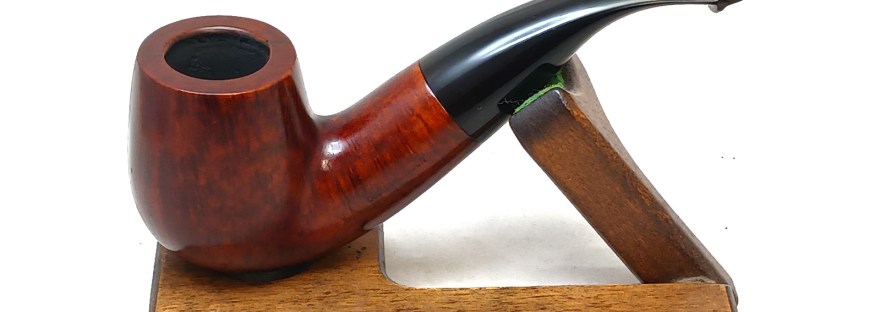
Peterson’s 9BC shape is a true classic of the marque. The Shape 9 bowl is an original Charles Peterson design, part of the Peterson catalog since 1896, and, though the 9BC is out of production, it can still be found in modern Peterson pipes stamped as a 307, 9S or XL90s. The 9BC is also referred to by collectors as a Chubby pipe, due to its short, tapered stem. The shape coding “B” indicates a Tapered stem, while the “C” indicates a short stem.
Many Peterson fans regard the 9BC as a “Holy Grail” pipe, to be acquired whenever possible. One such collector recently reached out to me to ask what might be done to save a Post-WWII Dublin & London 9BC that had definitely seen better days. This initial series of images shows the condition of the pipe as it looked on arrival at the shop.
From the sides, this pipe appears to be in fairly good estate condition, though the stem had a few obvious tooth dents and was lightly oxidized.


The shank is stamped on the left flank with “Peterson’s” over “Dublin & London”, and on the right flank with “Made in” over “Ireland” and “9BC”. Referring to Mark Irwin and Gary Malmberg’s excellent book, The Peterson Pipe, The Story of Kapp & Peterson, I quote from page 298:
First mentioned in a 1940 brochure, but probably not widely distributed until ’45, Dublin & London was the highest quality line (aside from the Supreme, introduced in ’53) until about ’86…. COMs include MADE IN over IRELAND (c. 1940-80) and MADE IN over THE REPUBLIC OF over IRELAND (c. 1980-97).


That makes the pipe on the bench a rather special piece of pipe history, produced sometime between 1940 and 1980. Now I understood why the pipe’s steward was so keen on this restoration, despite some very serious condition issues. I’ve saved these pics for last in an effort to recreate the excitement and the anxiety the pipe’s steward must have felt when he found the pipe.
As you can see, the pipe arrived severely cracked in not one but two places. Long, open cracks ran down the front and rear of the bowl. threatening to split the stummel in half. An area of charring near the middle of the front crack reaffirmed what my visual inspection had concluded. The crack was open straight through the chamber wall, and the pipe had been smoked for at least some time after the crack had appeared. Yikes!


This shot taken straight down the chamber from above, provides a hint to a possible cause of the extensive damage. A thick layer of carbon cake filled the chamber, leaving only a cone shaped depression down the centre. I’m willing to bet that an overabundance of cake, possibly aided by a natural weak spot in the briar, pushed the two halves of the bowl apart – a sobering reminder of what can happen to a prized pipe when regular maintenance is put off.

The stem, as previously mentioned, had a few marks, most notably a rectangular dent on the leading edge of the P-Lip button, and a shallower dent on the underside. For the time being, I removed the stem from the shank and set it aside. Cleaning it up would be easy enough, but pointless if I couldn’t repair the stummel.


In order to assess the full extent of the damage to the briar, I first needed to ream and clean the stummel. The carbon cake in the chamber was a bit stubborn, but did eventually surrender to my reamer. I worked carefully, expecting the bowl to shatter in my hand during the reaming, but in the end, the briar held together. I removed every spec of carbon to get my first good look at the cracks from the inside of the chamber.

As you can see, the rear crack was much longer inside the chamber than it was on the exterior of the pipe, stretching all the way down to just above the draft hole. The front crack was the opposite, short but wide open on the interior, and long and forking on the exterior.


To stop the cracks from progressing any further, I lightly sanded the damaged areas and traced the cracks to their ends near the bottom of the bowl, marking the end points with a Sharpie. These dots were then drilled with a 1.5mm drill bit to create a “firebreak”, a tiny hole that relieves the pressure on the briar, effectively halting the crack’s progress. Note that I did not drill completely through the chamber wall as that would leave the briar prone to a burnout at that spot.


To rebuild this Humpty Dumpty of a bowl, I’d need to insert a number of pins into the briar across the cracks. In these pictures, you can see my pinning layout lines, along with the “firebreak” holes drilled at the ends of each crack. The pins are deliberately set at opposing angles; this prevents them from simply pulling out of the briar as the bowl expands and contracts during use, and effectively stitches the briar back together. I’d need a total of 5 pins for this repair – three in the front and two across the rear.


This is where the repair gets a bit tricky. To keep the cosmetic touch-ups to a minimum, my crack pinning technique uses blind pin shafts drilled across the crack at an angle that keeps the pin shaft completely within the fabric of the chamber wall. One pin, one hole.
I took these pics after drilling the first pin shaft, with a length of brass rod run into the hole to illustrate the angles involved. Here again I used a 1.5mm drill bit and 1.5mm brass rod. This leaves just enough room in the pin shaft for some glue.

This pic shows that the pin shaft terminates inside the chamber wall rather than penetrating into the chamber. The red line indicates the approximate depth of the pin shaft.

I drilled the remaining pin shafts in the same manner.


With all the drilling done, it was time to install the pins that would bind this bowl back together. For each shaft, I measured and marked the length of the pin to ensure that, when fully seated in the shaft, the outer end of the pin would be buried inside the briar. If left too long, the pin could show a as brass dot on the surface of the pipe after final sanding.
After cutting a pin to length, I rolled it in some thick CA glue to coat it completely, then pushed it firmly home in its shaft. I had to work quickly at this point lest the glue set up before the pin was fully seated at the bottom of the pin shaft.

After installing all five pins, I mixed up more thick CA glue with roughly an equal part briar dust to make a filler. This was pushed into the cracks from the outside. I also made sure to fill the open ends of the pin shafts. As you can see, I was very generous when applying the CA and briar dust filler.


I took the filler over and across the rim of the bowl as well, but stopped at the inner rim edge. CA glue is not particularly heat resistant, so a different strategy is required for patching the cracks inside the tobacco chamber.

For this job, I turned to Original Formula JB Weld epoxy. Once cured, JB is highly heat resistant and completely inert, so there is no danger of the epoxy vapourizing during a smoke session. I mixed up a small amount of epoxy and pushed it into the cracks inside the chamber using a gloved finger. The goal here was to fill the cracks and any depressions in the chamber walls around the damaged area. Again, I was generous in my application to ensure full coverage.


JB Weld needs a good 24 hours to cure completely, so I set the bowl carefully aside to sit overnight. While I waited for the epoxy to cure, I spent a bit of time cleaning the original Vulcanite stem. A few pipe cleaners dipped in alcohol cleared a very light amount of tars from the stem, but the oxidized surface would need a bit of work.

To soften the oxidation on the surface of the Vulcanite, I popped the stem into a bath of Oxyclean and water and let it sit overnight.

When I came back to the shop the following day, I retrieved the stem and scrubbed away the now soft oxidation with a bit of Magic Eraser. When the stem was a uniform black colour again, I spent a few moments with needle file and sandpaper to smooth out the dents around the button.


And here is the stem, wet sanded to 2000-grit, ready for final buffing.

Then it was time to move back to the stummel. Patching briar is almost always a multi-step process, as CA glue tends to form tiny air bubbles in it as it cures (CA glue doesn’t “dry”; rather, it cures by a chemical exothermic reaction). When filed and sanded flush to the surrounding briar, the patches end up covered in tiny micro-pits, left overs from sanding through the air bubbles trapped inside the glue.

I would eventually need to completely refinish this stummel before sending the pipe home to its steward. A few strategically placed bits of masking tape kept the rather worn stamps safe while I sanded.


I also took time to remove as much of the excess JB Weld epoxy from the chamber as I could, leaving it only in the cracks. The chamber looks a bit weird at this point, but the walls are smooth to the touch.


To fill the micro-pits in the briar and help blend the repair into the final finish of the pipe, I coloured the patches using a stain pen before flooding the repairs with thin CA glue. This not only fills the micro-pits but also stains the exposed edges of the briar dust used in the filler medium.


I again let the CA glue cure completely before filing and sanding the surface smooth. I needed to go over a few spots more than once, but eventually I had the pits filled and the stummel ready for refinishing.
I decided on a Dark Brown stain here. It’s a shade darker than the original finish, but it helps push the repairs into the background, blending them into the darker grain lines in the briar. I applied a coat of Dark Brown Fiebing’s leather dye to the briar, let it dry, then hand buffed the excess dye from the surface with a soft towel. A wipe of mineral oil helped set the new finish while injecting some much needed moisture into the dry briar.


I let the oil sit on the stummel for a few minutes, then again hand buffed the briar with a clean towel to remove the excess oil. I then left the stummel to rest overnight again before coming back to finish off this rather technical restoration by applying a bowl coating to the chamber.
A bowl coating here is mostly a cosmetic upgrade, and isn’t strictly necessary, but I like the finished look and the coating provides a slightly grippy surface onto which a new protective layer of carbon cake can build. My bowl coating is very simple – a wipe of pure maple syrup across every surface of the chamber, followed by about a teaspoon of activated charcoal powder.
A pipe cleaner slipped through the airway stops the charcoal from drifting past the draft hole in the chamber. After wiping the maple syrup around the bowl, I drop in the charcoal powder, cover the open bowl with a piece of cardboard, and give the stummel a vigorous shake for a minute or two. This distributes the charcoal evenly around the bowl, leaving a smooth consistent surface after dumping out the excess.

The bowl coating needs to dry and harden somewhat to prevent the buffing wheels from simply stripping it away around the inner rim, so I left the pipe to rest for a few hours before remounting the stem and taking the finished pipe to the buffer.
A run on both the Red Tripoli and White Diamond wheels smoothed out any stray sanding scratches and brought up the shine on bowl and stem. A few light coats of Carnauba wax to the entire pipe added more shine and a layer of UV protection for the Vulcanite.
The finished pipe looks very little like the decrepit briar that entered the shop a few days earlier. Gone are the rather horrific cracks, and both briar and stem are clean, fresh and ready to be put back into active service. With a little care and feeding, this 1940-1980 Peterson Dublin & London 9BC should provide many more decades of smoking companionship to its new steward.
I hope you enjoyed watching this lovely Chubby Billiard come back to life. Bowl cracks are often the death knell for many pipes, but this project illustrates what can be done to save a prized briar from the bin. I, for one, consider the results well worth the effort to restore and preserve a piece of Peterson pipe history.
Until next time, Happy Piping! Here’s the finished pipe.


 dadspipes.com
Wow… very interesting. Thank you for sharing your work with us.
Your thoughts and techniques are fun to watch. It came out beautiful.
Blessings…
Rick
LikeLiked by 1 person
Thanks, Rick. I enjoy finding solutions to problems, which restorations like this one supply in spades. Keeps the brain working and the hands busy, and I get to put a vintage pipe back into service!
LikeLiked by 1 person
You are blessed Charles… I am too. To be able to do something we enjoy in life and believe we are making a positive difference is a Blessing.
Thank you for all you do and sharing it with us…
Blessings,
Rick
LikeLike