
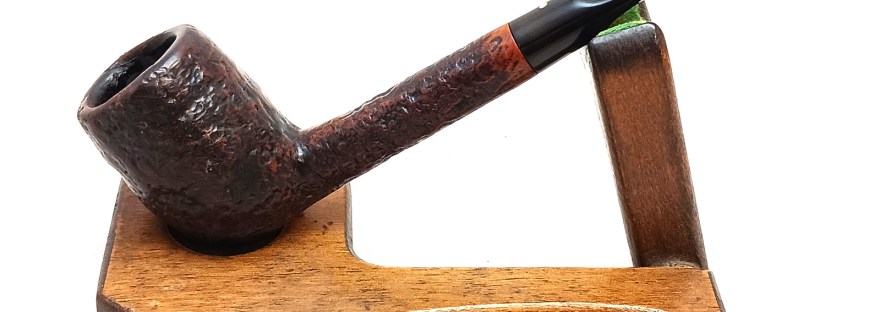
I have often said that any pipe is restorable if the will to do so exists. This project put that statement to the test as I faced down some significant challenges on this Patent Dunhill Lovat’s road to redemption. Sent to me by a Canadian college professor teaching in Massachusetts, the pipe had belonged to his late father and had obviously been a favourite.
The list of issues to overcome, however, was extensive – long vertical cracks on both sides of the bowl, poorly executed DIY repairs that would need undoing before redoing, heat damaged chamber walls, over-reamed chamber floor, a burnout straight down through the draft hole, and an ill-fitting, tooth-damaged stem. This series of pictures show the pipe’s condition upon arrival at the shop.


Interestingly, when I twisted the stem out of the shank, I discovered that the tenon had been replaced at some point in the pipe’s past.

The flat underside of the shank was quite dirty, but after a scrub with alcohol on a cotton swab, the stamps became much more legible. Unfortunately, the shape number had been obliterated by the burnout, but most of the rest of the nomenclature could be made out. It reads “Dunhill Shell Made in England” over “Patent No 1341418/20”.
If a date code had been stamped after “England,”, it had worn off over time. This makes dating the pipe rather difficult, but I was able to narrow it down a bit. The patent number was first used in the 1920s, but these early pipes were stamped with the possessive “Dunhill’s”. The apostrophe S was dropped in 1935, so, assuming the pipe in question was originally marked with a date stamp, and I’m reading the dating key on Pipephil.eu properly, the pipe was made between 1935 and 1943.

This Dunhill had certainly been through a lot in its 80 or so years, and the current steward, wanting it to be restored to smokable condition, gave me the green light to begin the work. To that end, I began the basic cleaning by reaming the old cake form the bowl. I worked carefully, not wanting to put too much pressure on the dubious old glue smeared over the cracks. Thankfully the old cake came away easily under the reamer head. I tidied the chamber up with some sandpaper wrapped around a dowel, then snapped a few reference pics.

In order to evaluate the state of the briar around the cracks, the old DIY glue repair had to go. I used a dental pick to carefully chip away the brittle glue to expose the extent of the damage. It was not confidence-inspiring. As you can see, there was a lot of briar loss, with some areas of the cracks wide open to the chamber.


To ensure the new repairs bonded well with the old briar, I scrubbed the stummel with Murphy’s Oil Soap and a toothbrush to lift away decades of dirt, oils and old wax.

A little surprisingly, the shank and airway of the stummel were relatively clean, needing only a handful of pipe cleaners and cotton swabs dipped in alcohol to clear out the old tars and debris.

Now that the briar was clean inside and out, the top priority was to shore up the structural integrity of the bowl. This would require inserting several pins across each crack to stitch the broken briar back together.
I started by tracing the extent of the cracks and drilling a 1mm hole at the far end to act as a “firestop”. The small holes don’t penetrate the chamber wall but are deep enough to stop the cracks from creeping further across the bowl.

Then it was time to lay out the pin lines. Shown below in silver Sharpie for clarity, the pins cross the cracks at opposing angles. This stops the pins from pulling out as the bowl expands and contracts during use.
I used a 1.5mm drill bit to bore the pin shafts. These are “blind shafts” which start on the exterior surface of the bowl, cross the crack within the briar wall and stop without penetrating the bowl on the other side. This reduces the number of holes to fill afterwards and ensures that the metal pins are fully enclosed within the briar.


After drilling the pin shafts, I added a drop of CA glue to the holes and pushed a length of brass rod into each shaft. The pins are cut short enough to sit fully within the chamber wall when fully seated in the shafts.

With all of the pins glued in, I covered the damaged areas completely with a mixture of CA glue and briar dust, overlapping the sound briar on either side of the cracks for a solid repair.


The briar dust and CA filler was extended up and over the rim of the bowl to fill the entire crack.

CA glue is a bad idea inside the tobacco chamber as it can vaporize under the heat of burning tobacco. Instead, I pressed some JB Weld epoxy into the damaged areas inside the chamber. It looks a bit heavy-handed in the pic below, but most of the epoxy would be sanded out after curing, leaving the epoxy only in the cracks.

While waiting for the bowl repairs to cure, I set to work cleaning up the stem. A handful of pipe cleaners dipped in alcohol cleared the tars from the airway.

Now that the shank and stem were clean, the stem seated snugly against the shank face again and I could work on the stem while it was mounted.

These close-up shots show several deep tooth dents on the bottom of the short saddle stem as well as tooth chatter hiding under the oxidation and mineral buildup.


After sanding the worst of the crust off the stem with some 320-grit paper, I drop filled the damaged areas with black CA glue. I let it cure completely before filing and sanding the patches smooth. A final wet sanding to 2000-grit prepared the stem for buffing.

With the stem sorted, I could turn my attention back to the stummel repairs. The CA and briar dust patches were left to cure overnight before I removed the excess material with a file. When the patches neared the surface of the briar, I switched tools, using a small round carving burr in my rotary tool to texture the patches to blend into the original sandblast finish.
The blast wasn’t particularly deep on this Shell Briar, so I had to pay attention and not allow the rotary tool to get away from me. A quick scrub with a brass bristle brush knocked the sharp edges off the newly textured surfaces.


The crack repairs were well in hand at this point, but the burnout through the draft hole still impaired the pipe’s structure and function. I needed to drill out the damage and install a plug of fresh briar before this Dunhill could be used again. Thankfully, the burnout was fairly compact and a 1/4-inch drill bit would do the job. Here you can see the pipe after drilling. The scrap of new briar shown would be used to make the plug.

Drilling a hole through a pipe is always a bit nerve-wracking. I think most pipe lovers will agree that this is not a pleasant sight.

The briar plug was shaped carefully by hand for a tight, flush fit in the hole. Here again I used JB Weld epoxy to glue the plug into the stummel. The draft hole of any pipe can be subjected to significant heat during use; JB Weld’s high heat tolerance makes it ideal for this application.


When the epoxy had cured, I filled the remaining depression around the briar plug with CA glue, sanding the repair flush after the glue had cured.

The end result is a nice, tidy and relatively unobtrusive repair.

With all the briar repairs completed, I could refinish the pipe, replicating the classic Dunhill Shell black-over-red finish with a coat of Black Cherry leather dye followed by a coat of black dye. A light buffing on the Tripoli wheel removed the black dye from the high spots, allowing the red undercoat to shine through.


The exterior of the pipe was looking really good at this point, so it was time to get the interior of the chamber spruced up. This shot shows the chamber after the briar plug was installed. As you can see, the draft hole needed some work to smooth things out and reopen the airway. The chamber walls at this point were also rough with a few pits visible.

I mixed up some pipe mud and applied it liberally to the chamber walls and floor, pushing it into the damaged areas for best coverage.


I let the mud dry overnight, then came back to the pipe and sanded the mud smooth. I chased the airway with a long drill bit to reopen the draft hole. Looking good!

As a final touch before taking the pipe to the buffer, I applied a bowl coating of maple syrup and activated charcoal powder to give the chamber a tidy look and provide a slightly grippy surface on which a new protective layer of cake can build.
The process here is simple – after wiping a few drops of syrup around the inside of the chamber, I filled the bowl with charcoal powder and let it sit for a few hours. The syrup absorbs the charcoal, and after dumping out the excess, the coating dries to a smooth, hard finish. For those of you wondering, the bowl coating adds a hint of sweet flavour to the first bowl or two of your favourite tobacco before fading away completely.

After giving the bowl coating time to harden, I took the completed pipe to the buffer where it was treated to a run on both the Red Tripoli and White Diamond wheels. A few light coats of Carnauba wax added shine and a layer of UV protection for the refreshed pipe.
I am quite pleased with the finished pipe. It was a lot of painstaking work, but the results speak for themselves. The pipe looks great from bowl to button, and the repairs blend invisibly with the original sandblast finish. Better yet, this old and well-loved Dunhill is once again whole and ready to provide another 80 years of service to its steward. May he enjoy it in good health.
I hope you enjoyed following along on this rather lengthy estate pipe rescue operation. While many pipe lovers may have decided to preserve this 1940s Shell Briar as a display piece or to scrap it outright, I’m glad to have been able to restore this family heirloom to useful condition for its new steward.
Until next time, Happy Piping! Here’s the finished pipe.


Wow, what a job, well done and I admire your creativity in finding solutions for those bowl issue
LikeLiked by 1 person
Thanks,. Al. Sound problem solving skills come in rather handy in this profession, especially when working with truly vintage pipes for which replacement parts are simply unavailable. At about 80 years young, this Dunhill seems quite modern compared to some pieces that have passed through the shop. 🙂
LikeLike
Definitely a labor of love. Taken from the shadow of death back into the light
LikeLiked by 1 person
Yes, I think this one was a close call. I’m glad the pipe’s steward decided to have it restored. It should now provide a few more decades of useful service, not to mention the memories it holds.
LikeLike
A masterclass of repair work Charles. Step by step. Just fantastic.
LikeLiked by 1 person
Thanks very much, Bill. A methodical approach is essential when dealing with extensive repairs like this Patent Dunhill. Each step prepares both you and the pipe for the next one and makes the process much easier. Kind of like that old joke about how to eat an elephant – one bite at a time! 😁
LikeLike
Good lord, this is definitely Lord Sauron levels of Necromancy well beyond restoration. The before and after is night and day, that is a work of art, amazing stuff Charles. Are you one of the blue Wizards, by any chance?
LikeLiked by 1 person
Thanks, Jonathan! There are times when I definitely feel more like the Magician’s Apprentice – runaway mop buckets and all – but I’m pleased with the results on this project. 😁
LikeLike