
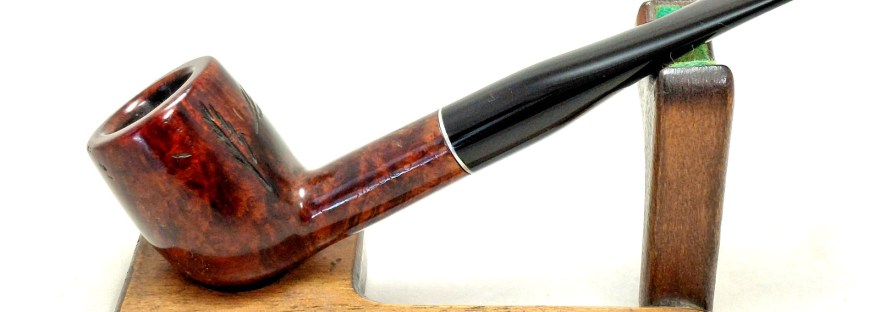
Medico pipes, and their famous paper filters, have been around since their introduction by the S.M. Frank company in 1933. Still in production today, Medico pipes are available in 13 finishes, 5 of Briar and the rest made of Brylon, a synthetic mix of briar dust and resins invented by S.M. Frank in 1966.
The specific Medico pipe on the bench today was sent in by a fellow Canadian pipe lover. The pipe, a classic Straight Billiard, had belonged to the current steward’s grandfather. It was sent in to DadsPipes for restoration for a few obvious reasons.
As this initial series of images shows, the pipe was in fairly good condition for its age, though very well loved. The rim of the briar bowl was hidden under a crust of carbon “lava” and the chamber had a thick layer of rather fuzzy looking cake clinging to the walls.


It was the stem, however, that posed the biggest issue. Grandpa had clearly been a clencher, as the pipe showed deep tooth dents on the top and bottom of the bite zone and a long crack running more or less from the dents to the button, cracking the stem in half.


Though faded and worn, the stamps are still legible on the left shank. They read “Medico” over “Imported Briar”. That’s not a lot of information to work with, but the leaf motif on the sides of the bowl help. I’d guess that this pipe was made sometime in the late 1960s or early 1970s.


Replacing a filter system stem requires a bit more work than replacing a non-filtered stem. The first task with this old Medico stem was to remove the aluminum tenon fitment in order to transplant it into the new Vulcanite stem. As I was examining the stem more closely, I noticed an “F” stamped into the top of the stem.
I’m not sure what the F stands for here. If any Medico afficionados out there can shed some light on the issue, please comment below!

I’ve found that the easiest way to remove aluminum tenons is by heating the stem until the glue holding the tenon in place lets go. Sometimes, like here, the tenon fitment is simply pressed into the stem face. Softening the Vulcanite at the end of the stem loosened its grip on the tenon.

The body of the stem went into the bin while the tenon fitment spent some time soaking in isopropyl alcohol to dissolve decades worth of tars and other gunk.

While the tenon soaked, I worked to clean the stummel, starting with reaming the old cake from the chamber. I followed the reamer heads with a bit of 220-grit sandpaper wrapped around a dowel to smooth and tidy the chamber walls.

The briar chamber walls were in excellent shape under all that cake.

Next, I uncovered the rim, first scraping the bulk of the carbon crust off with a knife blade, then finishing the job with some 0000 steel wool. The steel wool is hard enough to remove the carbon but soft enough to avoid scratching the briar.

Then it was back to the isopropyl alcohol with a handful of pipe cleaners and cotton swabs to clear the mortise and airway.

Similarly, the aluminum tenon fitment got a quick once over to make sure it was clean when I glued it into the new stem.

Speaking of which, the new Vulcanite stem began as a precast stem blank. The blank was a bit larger than the shank diameter, so I mounted it in the lathe and cut it down to just a hair over final dimensions. This is always good practice, both because it leaves the repairer with a bit of wiggle room in any direction if the stem is a bit off-centre and because pipe shanks are rarely truly round.
The shank of this Medico Billiard was slightly ovoid in cross-section, varying about one half millimeter out of round. The extra room on the new stem would allow me to compensate for this out of roundness without reshaping the shank.

With the blank turned to diameter, I cut off the integral tenon and used a series of drill bits to prepare the blank for the tenon fitment and filter. In this pic, you can see some of the drill bits marked for depth with tape. The stem’s airway needs to be opened up to 6mm to accept the filter, while a larger mortise is drilled to accommodate the tenon fitment.

A test fit showed all was well. So far, so good!


To secure the tenon fitment permanently in the stem face, I mixed up a small batch of JB Weld two-part epoxy. JB can handle a lot more heat than regular epoxy, and as the aluminum tenon will conduct heat more than a Vulcanite tenon will, I chose to add a bit of insurance here.

After mounting the tenon in the shank of the pipe, I applied the epoxy to both the tenon fitment and the stem mortise, then slid the parts together and lined everything up before the epoxy took hold.
As is my custom, I clamped the pipe upright in a small vise overnight. The positioning helps use gravity to keep the stem flat against the shank face while the epoxy cures. A wrap of tape adds insurance against side to side movement.

When I came back to the pipe the following day, I chased the stems airway with a drill bit to remove the inevitable excess epoxy and made sure that a Medico filter fit properly in the new stem.
As you can see in this pic below, I also took the time to file the “wings” off either side of the stem, removing the excess Vulcanite to create a smooth Round Taper stem profile.

When I was happy with the overall look of the new stem, I switched to sandpapers, sanding the stem with 220 through 2000 grit papers to erase the file scratches and prepare the stem for final buffing and polishing.

Before I took the pipe to the buffer, though, I wanted to freshen up the finish on the stummel. The old stain was looking a bit tired, so I wiped a coat of Fiebing’s Dark Brown leather dye over the briar, let it sit briefly, then hand buffed away the excess with a soft cloth.

A wipe of mineral oil helped to set the new stain and gave the finish some depth and pop. Again, I allowed the oil to sit briefly on the surface of the briar before hand buffing away the excess.

Then it really was time to take the restored pipe to the buffers for a run on the Red Tripoli and White Diamond wheels to polish away any stray sanding scratches and bring up the shine. A few light coats of Carnauba Wax added more shine and some UV protection for the refreshed pipe.
This old Medico is once again looking its best and will be put into its new stewards rack and rotation as a memento of his grandfather. I’m thrilled to have been able to play a small part in returning this family heirloom piece to useful condition. With a little care and feeding, the pipe’s steward may well be able to pass it down to his grandchildren in time.
I hope you enjoyed watching this 1960s Medico Billiard come back to life. I know I did!
Until next time, Happy Piping! Here’s the finished pipe.


 dadspipes.com
That’s a beauty! A good job well done. Thanks for sharing.
LikeLiked by 1 person
Thanks! I always enjoy sending a family heirloom home in functional condition. 😄
LikeLike