
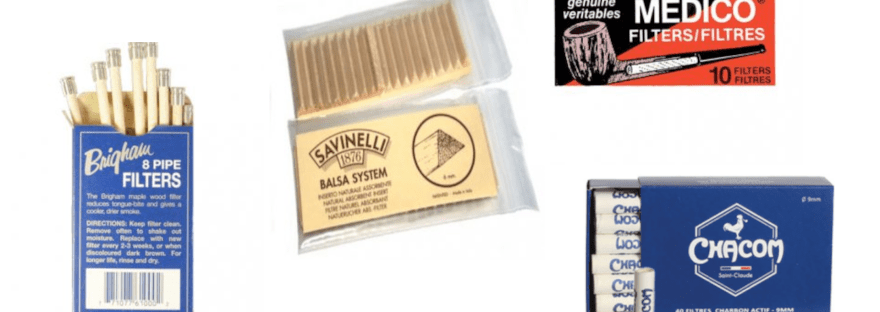
Filtered pipes have been around for a long time. The first rudimentary filters, primarily aimed at preventing bits of tobacco from entering the mouth, were introduced to the pipe smoking community in the middle of the 19th Century but filtered pipes didn’t really catch on commercially until the 1930s with the launch of Medico’s 6mm paper filter system in 1933 and Vauen’s 9mm charcoal filter in 1934.
Since then, other filter systems, like Savinelli’s balsa filter and Brigham’s Rock Maple filter, have entered the market, as have various “not-really-a-filter” aluminum condenser or “stinger” designs. Many other brands of nominally 6mm and 9mm cartridge style filters can be found at tobacconist shops around the world, along with pipes factory-made to use these filters.
With so many choices available to the modern pipe smoker, the easiest and most reliable way to add a filtered pipe to one’s rack and rotation is to simply buy a factory-made filtered pipe and a box of the correct filters. Most, if not all, European pipe makers now offer their pipes in both filtered and unfiltered versions, or accommodate both the Filter and No Filter camps by shipping their filtered pipes with adapters to reduce the airway to a standard 3mm diameter.
But what to do if you have an unfiltered pipe or two in your collection that you’d like to use with one of the many commercially available pipe filters? I’m asked this question regularly by mainly North American pipe smokers (where filters have been slow to catch on), and the answer is always “IT DEPENDS…”
The biggest issue with converting a pipe to accept a filter is real estate. The pipe must have the physical space to house a filter, either within the stem tenon, the shank or a combination of both.
As a pipe repairer and restorer, I do not drill out shank mortises to allow for a larger stem tenon to be installed. Besides requiring more and/or larger shop equipment, modifying the shank mortise can (and usually does) alter the geometry of the pipe and risks a mismatch between shank face and stem. Overcoming such a mismatch takes additional time and effort and drives up the cost of a conversion for the client. That is one can of worms I do not need to open.
So if we’re not re-drilling the shank mortise to accommodate a filter, we need to find enough space for one in the stem tenon.
My Rules for Filter Conversions
In order to simply drill out the stem’s airway to accept a filter, the tenon needs to be a minimum of 3mm larger than the target filter to allow for a tenon wall thickness of at least 1.5mm.
This means a minimum of a 9mm outer diameter for a 6mm filter, and a 12mm outer diameter for a 9mm filter. Even at those tolerances, Vulcanite and Acrylic tenons lose structural strength and become prone to shattering or snapping off, which is why most manufacturers install filter tenons made from Delrin, which retains its strength and structural integrity while machined down to less than 1mm in thickness.
Another major issue to consider is the fact that not all filters are the same size. A nominally 9mm filter can measure anywhere between about 8.7mm and 9.2mm in diameter. This variation can be confusing, as one might assume that any 6mm filter will fit in any pipe designed to accept a 6mm filter. The truth, however, is that filters tend to come in one of three sizes – too narrow, too fat or just right.
Length also plays an important role in creating the right filter “pocket” when converting a non-filtered pipe. A 6mm x 40mm filter requires a deeper filter pocket than a 6mm x 25mm filter, and while you may be able to make a longer filter fit a shorter cavity, you cannot stretch a short filter to fit a long cavity.
Because of this variation in actual filter dimensions, I make it a rule to ask clients to provide a sample of their favourite filter when sending in a pipe for conversion. This way, I can ensure that the filter fits snugly in the tenon without binding and without too much open air around the filter, which could lead to unfiltered smoke sneaking past the body of the filter.
So let’s recap with a few bullet points. When you are evaluating a non-filtered pipe for possible conversion to a filtered pipe, be aware of the following:
- The Outer Diameter of the Tenon – This must be at least 3mm larger than the nominal diameter of the target filter (9mm minimum for 6mm filters, and 12mm minimum for 9mm filters).
- Tenon Material – Vulcanite and Acrylic tenons that are close to the minimum required outer diameter may need to be replaced with stronger tenons made from Delrin.
- Your Filter of Choice – send in a sample filter with the pipe. Do not assume that another brand of filter will fit the pipe without adjustments, which may or may not be possible without reworking the stem altogether.
A Third Option – Add-On Filters
If your pipe is not suitable for an internal filter, or you don’t want to change the internal structure of the pipe, an add-on filter of some kind may be an option. For example, Nording Keystones can be added to the bottom of any pipe bowl before tobacco is packed into the pipe.
I was also recently commissioned to create an inline filter housing to add a standard 6mm Dr Grabow paper filter to a Churchwarden pipe. The filter housing connects to the shank mortise and the pipe stem fits a mortise drilled in the opposite end of the housing. The two halves unscrew to allow the filter to be inserted or removed. The device adds just over three inches to the pipe’s overall length, which must be taken into consideration, but it does effectively bypass all of the filter conversion requirements listed above.


Summary
Let’s be honest – no filter makes smoking tobacco safe or healthy, but filtered pipes can help reduce the amount of moisture in the smoke stream, mitigate gurgling and tongue bite and remove at least some of the tar and nicotine from the smoke. On the other side, some pipe smokers find that filters mute the flavour of their favourite blend, can be difficult to remove from the pipe, and, in North America at least, can be difficult to source if you’re not lucky enough to have a good local tobacconist.
In the end, “To Filter or Not to Filter” is a question of personal preference. I encourage every pipe smoker to try a filtered pipe at least once before writing them off. It’s the only way you’ll find out if filters are for you. If they are, there is a whole new world of filtered pipes awaiting you; if not, an adapter can be purchased or made to convert your filtered pipe to a standard airway.
And if you do find yourself wishing some of the pipes in your rack could take a filter, do your due diligence and run through the points above to make sure a conversion is even possible before paying to ship out your cherished briars for the work.
I hope this little treatise on pipe filters helped to clarify a few things for you. Filter conversion often seems like it should be a simple procedure, but the reality is that there are some hard limits on what can be achieved in practice.
Thanks for joining me for this post. Until next time, Happy Piping!

 dadspipes.com