
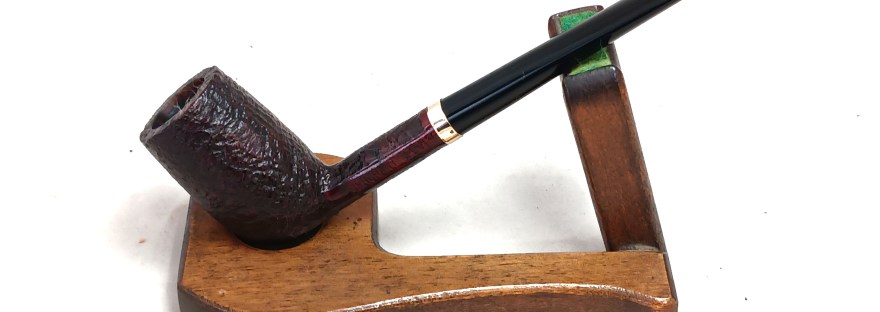
Merchant Service pipes were made famous in the late 1930s and 1940s by superstar entertainer Bing Crosby, who was a fan of the simple yet elegant pencil shanked billiards originally produced by Herbert Merchant Inc. Herbert Merchant died in 1944, and original production of Merchant Service pipes seems to have stopped sometime in the early 1970s.
The current owners of the brand have revived production, with their Merchant Service Standard pipe a very close match to the pipes Crosby enjoyed so much. The brand has since branched out, recreating several more classic British pipe shapes.
I’m a Crosby fan myself, both of his music and movies and of the thoroughly competent and effortless manner in which he packed, lit and smoked a pipe, both on set and off. Watching Bing scratch a match with his thumbnail to light his pipe in the movie White Christmas was a revelation to me as a younger pipe smoker!
Fandom aside, as a repairer, the “Bing” shaped pipes can present a real challenge. The oh so thin pencil shanks are elegant, but also prone to cracking. The Merchant Service pipe on the work table today is a good example.
As you can see from these initial images taken when the pipe arrived, the pipe had suffered a mishap which snapped the tenon off the stem. The rest of the pipe was in excellent condition, with only a bit of cake in the chamber to trim down.


The left shank is stamped “Merchant Service”. It is the only stamp on the pipe, just like the original production.

The pipe’s steward had managed to remove the remains of the tenon from the shank. Whenever I run into a broken tenon, I assume there is also damage to the shank, either from the accident that caused the break or from torquing the shank sideways while removing the old tenon. This pic of the shank face shows a couple of suspicious spots but no obvious cracks.

The pipe was very clean when it arrived, but I gave it a quick once-over to be sure. The carbon cake in the chamber surrendered easily to sandpaper wrapped around a dowel, and the shank and airway both proved to be quite clean already.


Before I could install a new tenon into the stem, I needed to remove the stump of the old one and face the stem square and flat. This can be a bit tricky for the novice restorer as it’s easy to sand an angle into the stem face if you’re not paying attention. Thankfully for me, a few short minutes on the topping board prepper the stem face for drilling.


To drill a mortise for the tenon to glue into, it is necessary to enlarge the airway. The trick here is again to stay properly aligned with the existing airway – not an easy task when drilling by hand. To use the airway as a guide for the drill bits, I used a total of 10 bits, each a hair larger than the last, to slowly but surely enlarge the airway to create the necessary mortise.

Taking some measurements from the shank mortise, I turned a short section of Delrin rod in the lathe to the correct diameter and drilled an airway through it to create a tenon. On test fitting the tenon in the shank, however, I discovered a bit more damage than anticipated. The fall that had broken the original tenon had, indeed, cracked the shank.

A dig through my supplies came up with a thin brass shank band of the correct size for this very slender shank. Once installed, the band would hold the crack firmly closed and prevent its spread. As a bonus, the band was thin enough not to encroach on the stamps.
After a test fit, I used a few drops of CA glue to install the band onto the shank.


With that little diversion sorted out, I went back to the tenon replacement. I mixed up a small amount of JB Kwik epoxy, applied it to both the inside of the stem mortise and the exterior of the tenon, and slid the parts together. It’s important to make sure that no excess epoxy squeezes out around the new tenon as it could potentially bond the stem and shank together permanently.

After assembling the pipe, I clamped the pipe upright to let gravity assist in keeping the stem flat against the shank face. After the epoxy began to grab, I added a wrap of masking tape to hold the parts in position overnight.

When I came back to the pipe the next morning, the epoxy had fully cured and I could safely twist the stem out of the shank and chase the airway through the tenon and stem with a long tapered drill bit to clear the excess epoxy

Then it was time to take the pipe to the buffer for final polishing. I gave it a light run on both the Red Tripoli and White Diamond wheels to remove any light handling marks and bring up the shine. A few light coats of Carnauba wax added more shine and a layer of UV protection.
After its time on the bench, this Merchant Service Pencil Billiard is ready to retake its place in its steward’s rack and rotation. While not exactly to factory spec, the brass shank band adds a nice touch of bling to the pipe without obscuring the nomenclature. With a little care and feeding, this pipe should serve well for many years to come.
I hope you enjoyed following along on this restoration. Until next time, Happy Piping!
Here’s the finished pipe.


 dadspipes.com