
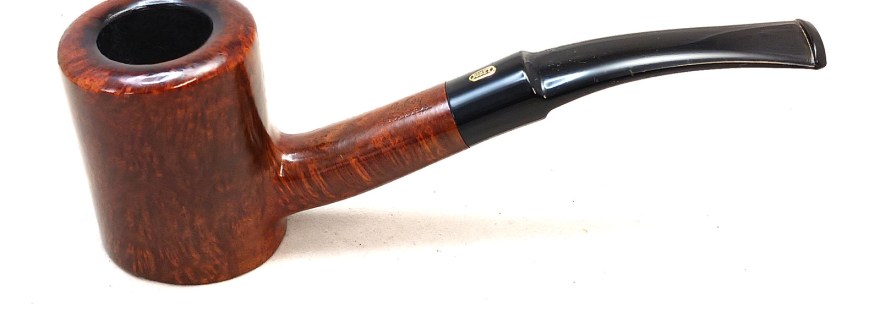
Jobey pipes have been around in one form or another, made by one company or another, since about the end of World War I. The predominant appraisal of Jobey pipes over the years is that they were “good pipes for the price”. Jobey made pipes in mostly classic shapes sold at low to midrange prices, and the marque may have simply faded to obscurity if it had not been for the introduction of the “Jobey Link ” tenon in 1970.
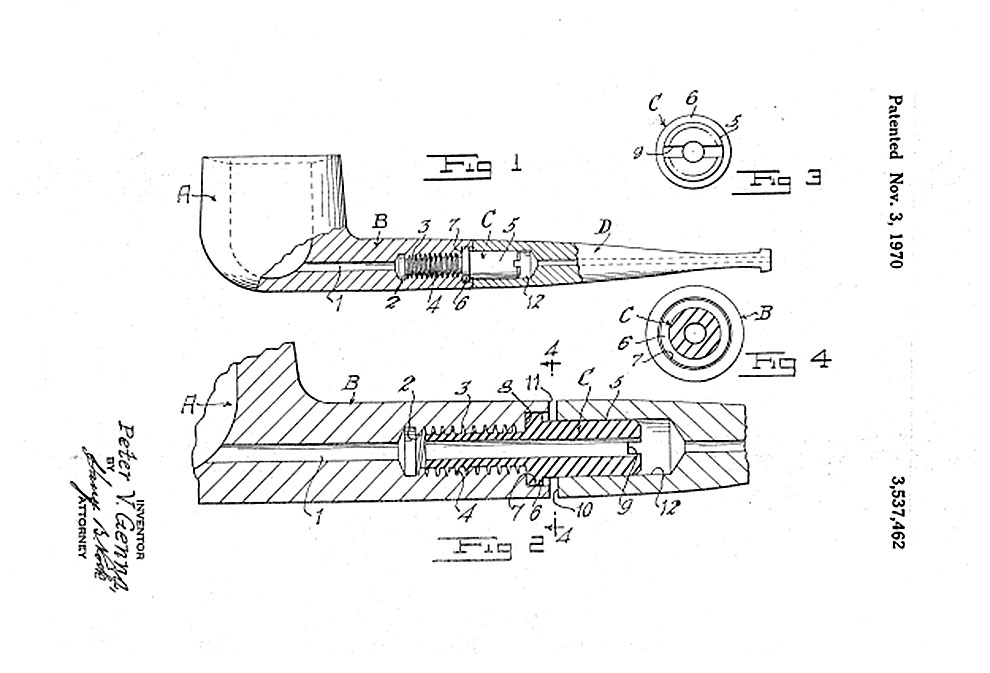
The Jobey Link is essentially a Reverse Tenon which threads into the shank of the pipe, leaving a smooth push tenon over which the pipe stem is friction fit. This image, borrowed from the Jobey page on Pipedia.org, shows the patent drawing for the Link.
Sadly, the brand is no longer in production, sold as a ghost brand to Butz-Choquin in St Claude, France in the late 1980s. It seems there was an unsuccessful attempt to revive brand back in the early 2000s, but any current Jobey pipes listed for sale appear to be estate pipes.
The pipe on the table today, a handsome Poker shape, likely hails from the late 1960s as it is stamped “Patent Pending” on the shank, along with the more standard “Jobey” logo over “Extra”.
As this series of images show, the pipe itself was in pretty good condition. It needed a cleaning and waxing, but there were no scorches, cracks or other structural issues with the stummel.
The stem, which carries a brass Jobey logo on the top, was lightly oxidized. The biggest issue with the pipe, other than the broken tenon, was a collection of deep tooth dents in the underside of the stem behind the button.


Here is an end on shot of the Jobey stem, with its (dirty) mortise.

And the requisite shots of the stamps.


The pipe’s steward had included with the pipe the remains of the original Jobey Link, now snapped in half. The threaded end on the left screwed into the shank, while the larger smooth end formed the tenon for the stem. Not surprisingly, the Link had snapped at the weakest point, just behind the collar where the threaded end of the tenon begins.

I began the restoration work, as always, by ensuring that the pipe was clean inside and out. A few cotton swabs and pipe cleaners dealt with a small amount of tars and debris stuck in the shank and airway. The chamber had very little cake build-up, so I simply gave it a quick smoothing out with sandpaper wrapped around a dowel.

The crowned rim had a light layer of carbon crust on it when the pipe arrived, but it surrendered easily to a quick scrub.

That completed the prep work on the stummel, but there was a decision to be made about the stem. If you lurk around pipe restoration forums online, you’ll probably come across a few different recipes for filling damaged Vulcanite stems – CA glue mixed with charcoal dust, CA glue mixed with Vulcanite dust, rubberized black CA glue are all at the top of such lists.
I have tried all of these patch materials over my decade plus of pipe restorations, but all fall short, in my opinion, due to one thing. They all eventually fail. CA glue is much harder than Vulcanite and does not oxidize like Vulcanite when exposed to sunlight or saliva.
What this means is that eventually a CA glue patch in Vulcanite will fall out as the two materials expand and contract at different rates, or the surrounding Vulcanite will oxidize around and even under the edge of a CA glue patch, leaving a blemish on the stem that cannot be polished out. Patching a Vulcanite stem also takes quite a bit of time, which is fine if you’re DIYing a repair at home but not so good when you’re running a business.
For all these reasons, I have stopped offering repairs to Vulcanite stems except in limited circumstances where the stem carries patent numbers or is otherwise historically significant to the pipe. It is much faster for me to replace a Vulcanite stem altogether, and, while the client pays slightly more up front, he or she receives much better value for dollar in longevity and functionality of the pipe.
I discussed all of this with the pipe’s steward, who in the end decided that keeping the original stem with the pipe was important to him. Decision made and fair enough. Let’s rehab the original stem as best we can.
My first task with any dented Vulcanite is to attempt to raise the dents with heat. Vulcanite has a bit of “muscle memory” when warmed and seeks to return to its original shape. Applying heat to the deep tooth dents can, in about 30% of cases, cause the compressed material under the dent to rebound, raising the floor of the dent and making it easier to smooth out the stem.
I used a lighter flame to heat the underside of the stem, with some improvement to the dents on the left and center, but as this pic shows, the Vulcanite did not puff back up to its original levels.

I sanded the dented area with 220 and 320-grit sandpapers to minimize the remaining blemishes, then wet sanded the entire stem with 800 and 2000 grit papers to smooth out the sanding scratches and remove the layer of light oxidation. I had a bit more work to do in the corners of the saddle and button, but the stem was starting to look smooth and black again.


Since Jobey pipes are no longer in production, neither are replacement Jobey Links, though they may still be available for purchase through JHLowe.com. Ordering anything shipped from the United States to Canada, however, has become an exercise in frustration, given the current trade situation and the on again, off again strikes at Canada Post. In the end, rather than attempt to order parts that may or may not be available, I decided to channel my inner machinist and simply make my own Jobey Link from a section of Delrin rod.
After taking some careful measurements from the original, broken, Jobey Link, I mounted the Delrin in the lathe and got to work replicating the part. My apologies for not photographing the work in progress, but this pic shows the new shop-made Link under the original broken tenon. Not too shabby!


From my research, Jobey made Links in several different sizes. This one came out to just over 8mm in diameter for the tenon end and a standard Imperial 14-20 thread on the shank end. A quick test fit proved my work with a good, snug fit to both shank and stem.


Now all that was left to do was to bring the repaired pipe to the buffers for a run on both the Red Tripoli and White Diamond wheels to polish the pipe and bring up the shine. A few light coats of Carnauba wax over the entire pipe added more shine and a layer of UV protection for the now jet black Vulcanite.
The finished pipe is looking sharp and, better still, is back in one piece and ready to return to its steward’s rack and rotation. Apart from making up the replacement Jobey Link, this restoration was little more than a basic Ream & Clean, but what a difference it made!
The pipe that arrived a few short days earlier was tired looking and a little down at heel. After its time on the bench, this Jobey Extra Patent Pending Bent Poker is once again clean, fresh and looking its best. And I got to add a new part to my “Made it Myself” list!
Thanks for following along with this gentle but still significant estate pipe transformation that highlights the power of a little basic maintenance. Until next time, Happy Piping!
Here’s the finished pipe.


 dadspipes.com
As always… great work… nice finished product…
Blessings…
Rick
LikeLike