
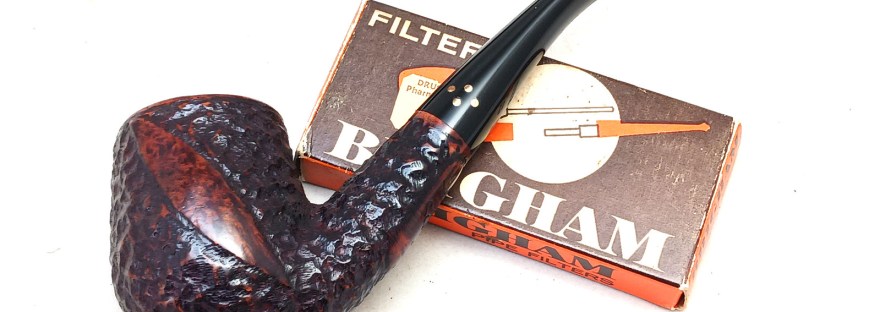
Toronto’s Brigham Pipes Limited was a company in flux in the 1970s. After enjoying decades of growth and increased sales, the pipe industry suffered a global drop in demand, and by the middle of the 1970s, Brigham had truncated its main line of production pipes from seven quality levels to only five. Apart from the Norseman and Valhalla lines of “Scandinavian-inspired” freehand shapes, a 5-Dot was Brigham’s best offering for most of the 1970s.
That makes the 4-Dot Brigham Bent Billiard on the bench today somewhat interesting, historically speaking, as it was much closer to a top-of-the-line pipe than its 4-Dot brethren manufactured a decade previously. I also personally have a bit of a soft spot for these vintage Brigham pipes. The aluminum tenons with which they were fitted were discontinued in about 2001 with the advent of the modern composite tenon. This can make working on older Brigham pipes a significant challenge, but I’d hate for this job to become boring!
As this initial series of images illustrates, the pipe was in fairly good estate condition for a 50 year old pipe, though it did show signs of wear and use. The finish was a bit worn and dirty, the outer rim was scuffed and dented, and the chamber was thick with carbon cake. The original Vulcanite stem was lightly oxidized and sported a large, deep tooth dent in the underside of the button, and a bit of tooth chatter on the upper surface.


The pipe is stamped with “424” followed by “Brigham” over “Made in Canada”. This tells us that the pipe is a 4-Dot grade, Shape 24 (Bent Billiard). The style of COM stamp shown was used between 1970 and 1979, providing a period of manufacture for this pipe.

One of the first things I always check when examining a vintage Brigham pipe is the aluminum tenon. Sometimes, especially if a wet filter is left in place, the aluminum can corrode, usually beginning at the end of the tenon where the head of the filter sits.
I was relieved, then, to twist the stem out of the shank and see that the aluminum tenon on this Brigham was in excellent condition. As previously mentioned, these aluminum parts have not been manufactured in 25 years or so, making the sourcing of replacement parts more than a bit tricky.


As a matter of course with Vulcanite/Ebonite stems with deep tooth dents, I first attempted to raise the dent using heat, in this case by “painting” the flame of a lighter over the damaged area. Vulcanite has a bit of “muscle memory” and, when warmed sufficiently, often attempts to regain its original cast shape.

This works for raising tooth dents about 35% of the time, in my experience, but is always worth trying. The dent DID move when I heated the end of the stem, but unfortunately, my attempt to “fluff up” the compressed Vulcanite instead revealed a crack in the underside of the stem along the lefthand edge of the dent.
This stem was one good chomp away from having a triangular chuck of Vulcanite break off the underside of the stem. To ensure reliability going forward, the stem would need to be replaced.

On the up side, the aluminum tenon was in good shape and could thus be transplanted into a new Vulcanite stem. But before I could do that, I needed to clean the stummel and assess the briar for any other issues that might need addressing while the pipe was on the bench.
I began by reaming the chamber to remove the heavy buildup of old carbon cake. When the reamer head approached the briar walls and floor of the tobacco chamber, I switched to sandpaper wrapped around a dowel to remove the last traces of cake and smooth things out.

The carbon cake, though excessive, had done its job of protecting the briar underneath.

With the chamber ready, I moved on to cleaning the shank and airway using a handful of cotton swabs and pipe cleaners dipped in 99% isopropyl alcohol.

This close shot shows the sorry state of the rim edge. The pipe had clearly been knocked on a few hard surfaces over the last half century.

To smarten the pipe up again, I spent a few minutes carefully sanding the rim with a variety of sandpapers, first smoothing out the ragged edges, then wet sanding to 2000-grit.

The last stage of the initial cleaning process was to scrub the rusticated finish with Murphy’s Oil Soap and a toothbrush. The smooth leaf motifs on either side of the bowl are typical of the 1970s for Brigham, and provide a nice contrast with the darker stained rustication. Both finishes looked much better after a good scrubbing and rinsing away of decades of dust, dirt, oils and waxes.

I set the stummel aside to rest and dry while I began work on the new Brigham System stem. The first job was to salvage the aluminum tenon from the old, damaged stem. The process here is quite easy.
The first pin in a 1, 2 ,3 or 4-Dot Brigham pipe anchors the aluminum tenon into the stem face, so I heated the stem over my heat gun until the Vulcanite became pliable, then I pushed the first of the four brass pins down into the space drilled for the filter and wiggled the tenon out of the stem. A small drill bit makes an excellent pushrod.

This pic shows the salvaged tenon dry-fit into the new Vulcanite stem blank. To get to this point, I drilled the stem twice – once with a 3/16″ drill bit to create the filter pocket in the airway, then again with a 7.5mm drill bit to make a mortise for the end of the aluminum tenon. Note the masking tape marking the depths on the drill bits.

Another dry fit, this time to the shank, proved that all the parts lined up properly with a Brigham filter in place.

One of the trickier parts of making up a vintage Brigham System stem, assuming you have all the parts necessary, is adding the iconic Brigham Dots. One and Two Dot pinning patterns are simple enough, but three or more Dots gets complicated quickly.
Traditionally, the craftsmen at Brigham drilled the Dot holes freehand, which is what I do for the simpler pinning patterns. For this 4 Dot stem, however, I preferred to use a bit of mechanical assistance in the form of my cross-slide vise and drill press.
As the name suggests, the table of a cross-slide vise can be adjusted on two axis – left-right and in-out. The seam running lengthwise down the side of a Vulcanite stem blank provides a great reference line for drilling the horizontal Dots. The drill placement for the vertical Dots is a bit trickier, but becomes second nature with a bit of practice.

Installing the brass Dots is easer when the stem is firmly attached to the tenon, so I mixed up a small amount of JB Kwik high heat epoxy and applied it to both the outside of the tenon and the inside of the mortise drilled in the stem face.

I slid the parts together, making sure there was no excess epoxy caught between stem and shank face, then clamped the pipe upright in a small vise while I used both hands to align and position the stem correctly. A wrap of masking tape (not shown) held the stem in position overnight while the epoxy cured completely.

When I came back to the pipe the next day, I checked that the tenon had glued up properly, then cut four short sections of 1/16″ brass rod and installed them in the pre-drilled holes, securing each pin with a drop of CA glue.

When the glue had cured, I filed the brass rods flush to the surrounding Vulcanite and took this first image of the new pinning pattern. Not too shabby!


The new Vulcanite stem was only slightly larger than the shank on this Bent Billiard, so after a quick bit of file work to knock the rough edges down, I switched to working with 220 and 320-grit sandpaper to both fit the new stem to the shank and refine the profile of the new stem to better match that of the original.

When I was happy with the overall look of the new stem, I moved to finer, wet sandpaper in 800 and 2000 grit to remove the sanding scratches left by the coarser abrasives and prepare the Vulcanite for final polishing.

I had cleared the excess epoxy from the stem’s airway after the initial glue-up, but a test fit with a Brigham Rock Maple filter showed that there were a few pinch points left. A bit more work with a drill bit, turned by hand, and a needle file opened the airway completely, allowing the filter to insert easily and seat properly.


Double checking the fit of a filter in the System stem is vital, both for ease of use and as preparation for bending the stem. It is absolutely essential that a filter be installed in the stem before bending, as otherwise there is a real risk that a filter will NOT fit in the stem afterwards.
Unlike modern Brigham pipes, whose composite tenons are a standard length, vintage aluminum tenons varied in length depending on the shape of the pipe. That means there is no way to drill a standard filter pocket in a vintage replacement stem. Likewise, there can be no standard place to bend a vintage Brigham System stem, so having a filter in place in the stem while the stem is heated and bent is a must.
Applying the bend is simple enough. I slipped a pipe cleaner through the stem to prevent kinking or collapsing the airway, then heated the Vulcanite over the heat gun until it became pliable. The stem was then bent to the required shape. A quick run under cold water cooled the Vulcanite and set the new shape.

Just before taking this refreshed Brigham to the buffer for polishing and waxing, I touched up the finish on the rim using a furniture touch-up marker, matching the finish on the smooth leaf motifs on the sides of the bowl.

Then it was time to finish off this restoration with a run on the buffing wheels. The Red Tripoli wheel smoothed out any remaining sanding scratches in the Vulcanite and began to build the shine. A second buffing, this time on the White Diamond wheel for the entire pipe, added more shine. A few light coats of Carnauba wax completed the process and provided a level of UV protection for stem and stummel.
This 1970s Brigham 424 Bent Billiard is once again whole, undamaged and ready to enjoy. The new System stem looks like it’s always been part of this pipe, which is now ready to take its place in its new steward’s rack and rotation. May it serve him faithfully for at least another 50 years!
Thanks for joining me for another estate pipe restoration. I hope you enjoyed watching this pipe come back to life as much as I did. Until next time, Happy Piping!
Here’s the finished pipe.


 dadspipes.com