
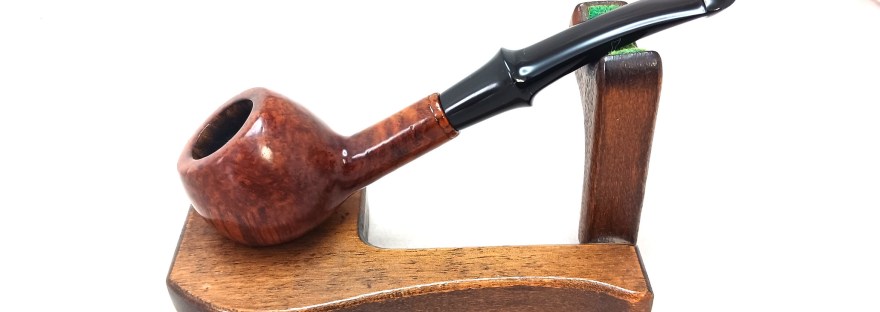
The Peterson Dunmore line, first launched in collaboration with Iwan Reis in 1971, was, according to this article by Mark Irwin, an attempt “to modernize the System pipe by removing what was perceived as the old-fashioned nickel mount.” The series also featured a faux-Army mount stem and a carved beaded detail at the end of the shank. This image, also borrowed from Mark’s article, shows a Dunmore series 406 Prince in its full glory.

This, and other images of the Dunmore line on Mark’s blog helped me considerably when presented recently with a Peterson Dunmore stummel that arrived without its stem. The pipe’s steward wished to have a period-correct P-Lip stem fitted to the pipe in order to render it complete and useable.
As you may or may not be aware, replacement P-lip stem blanks have become somewhat difficult to source lately. Many of the so-called P-Lip precast Vulcanite stem blanks available through the normal supply channels are faux P-Lip stem, where the airway exits straight out the end of the button instead of up through the top of the button as Charles Peterson originally designed, limiting the choice for pipe smokers even more.
Hoping to spare the pipe’s steward the cost of a hand cut replacement stem, I dug through my stock of P-Lip stem blanks and came up with one that I thought just might be modified to suit the purpose. This pic shows the stem blank alongside the stummel. It was a proper P-Lip button, and a good match for length and width, but obviously needed some tweaking to look the part of an original Dunmore stem.

For this shot, I held the shank above the tenon portion of the stem to get a sense of overall scale and balance between the stem and stummel.

The stamps on the stummel were worn but legible (if tricky to photograph). The left shank reads “Peterson’s” in script over “Dunmore”, in quotation marks. The right shank, which I failed to get a pic of somehow, carries the “Made in the Republic of Ireland” stamp and a shape number, “406”. This pic shows the (worn) beaded finish on the shank nicely .

The stummel had arrived already cleaned, so I moved straight to sizing the tenon on the new stem. And that’s where we hit the next roadblock. If you look very closely at the picture above, you can just make out a hairline crack running along the shank above the stamps. Mounting the replacement stem in the mortise revealed the damage clearly. Ouch!

So much for an easy restoration, but such is life when dealing with vintage pipes with unknown pasts. The easier repair here would have been to add a shank band to the stummel to hold the crack shut tightly. Doing so, however, would have hidden the beaded detail on the shank end under the band, and the pipe’s steward had a definite preference for an all-original look.

Thankfully, a few measurements confirmed to me that the stummel was a candidate for an internal shank repair using a briar sleeve. This is not usually possible on pipes with shank mortises under about 8mm in diameter, unless the shank was significantly beefier than the mortise drilling. The mortise on this Dunmore Prince measured in at 8.25mm in diameter, just a hair above the cut-off line.
An internal sleeve repair takes about 2mm off the size of the original mortise once the sleeve is glued into place. In this case, that meant a tenon diameter of about 6mm when all was said and done, which is generally as small as one would care to go on the stem to shank connection.
I started off the repair by reaming the shank mortise by hand using an 8mm drill bit. This ensures that the sleeve will fit the entire length of the crack without having to deal with obstructions.

Then it was time to make the briar sleeve. I keep a few briar pen blanks on hand in the shop for just such repairs. After cutting off the required length of briar from the pen blank, I mounted it in the lathe and drilled a starter airway at 1/8″ through the block. A second drilling opened the airway to 6mm, after which I turned the square block down to create a briar cylinder, as shown in the second pic below.

A test fit showed that the briar tube fit neatly into the shank mortise with a bit of room for epoxy, so I cut the tube off the briar block and took the parts back to the bench for the glue-up.

After adjusting the briar sleeve for length, I mixed a small amount of two-part epoxy and applied it to both the inside of the shank mortise and the outside of the briar sleeve.

This pic shows the sleeve pushed home in the mortise. I’ve also already wiped away the excess epoxy from the end of the shank. Thus prepped, I set the stummel aside for the night to give the epoxy time to fully cure.

When I came back to the pipe the following day, I chased the new, reduced mortise with a drill bit to clear any excess epoxy from the shank, then mounted the replacement stem in the lathe for some reshaping. The cylindrical shoulder of the saddle stem was tapered to create the familiar Peterson flare, while I also reduced the tenon to fit snugly in the new shank mortise.

This pic shows the repaired stummel and the freshly shaped replacement stem.

I mounted the new stem in the shank and took these next pics. Looking good, but the stem still needed a bit of shaping to pinch the waist area in slightly and, of course, some filing and sanding to remove the molding marks and prep the stem for polishing.


A half-round file made fairly short work on the slightly pinched waist, after which I followed up with hand sanding from 220 to 2000 grit.

I finished up the repair work on this 50 or so year old Peterson by introducing a slight bend into the stem. This is accomplished by warming the Vulcanite stem over the heat gun until pliable, adding the required bend, then running the stem under cold water to cool it and set the new shape.

Then it was time for final buffing and waxing. I gave the entire pipe a run on both the Red Tripoli and White Diamond buffing wheels to erase any stray sanding scratches and bring up the shine. A few light coats of Carnauba wax added to the shine and provided a modicum of UV protection to the freshly restored pipe.
The finished pipe is once again structurally sound, complete and ready to provide decades of smoking companionship to its new steward. I’m very pleased to have been able to not only return the pipe to useful service but also maintain the original factory appearance of the pipe.
I hope you enjoyed following along on this estate pipe restoration and learning a bit about the short-lived Peterson Dunmore line. Until next time, Happy Piping!
Here’s the finished pipe.


 dadspipes.com