
Pipe smokers can usually be sorted into one of two camps when it comes to pipe maintenance. On one side are the pipe stewards who go out of their way not to damage their pipes in any way. These folks may clean the pipe after each and every smoke, never ream carbon cake with a pen knife and protect their stems with rubber Softie bits. In the other camp are those who consider their pipes as more utilitarian objects and allow them to wear more naturally, leave more cake in the chamber and don’t get too fussed by visible signs of wear on the stem.
Either philosophy, taken to extremes, can be problematic. Yes, it is entirely possible to clean your pipe too much. I have seen bowls split in twain by deodorizing salt treatments and acrylic stems crazed by too much high-proof alcohol. At the other end of the stick, I’ve seen chambers completely clogged with cake, allowing no air to be drawn through the pipe and cracked or broken stems crudely glued back together or simply cut off behind the damage and pressed back into service.
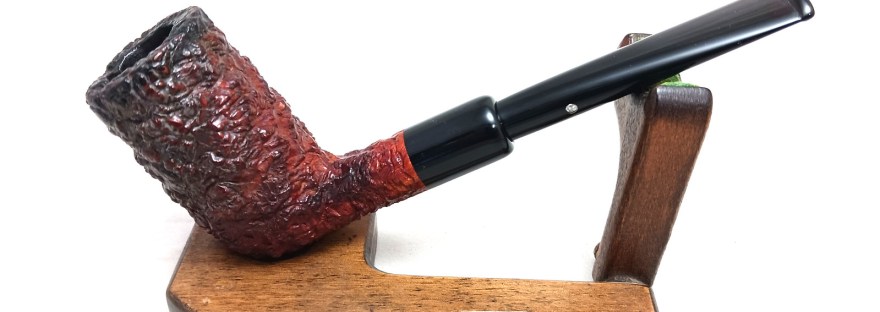
Thankfully, the vast majority of pipe lovers fall toward the centre of the maintenance continuum, keeping their pipes in good working order. Such is the case for today’s patient, a Castello Old Sea Rock Chimney or Stacked Billiard. As these initial images show, the pipe was in decent estate condition when it arrived on the bench for some TLC. The stummel was dirty, with a fair bit of dust and old wax lodged in the nooks and crannies of the deep Sea Rock rustication, but the Fumee (Smoked) finish made the top half of the bowl appear grimier than it was.


The biggest cosmetic issue was the stem, which had been well and truly chewed on by its former steward. As this pipe was destined for a new steward, my task was to return the stem and the rest of the pipe to as close to factory fresh as possible.


The smooth underside of the stummel was stamped “SK” followed by “Castello” over “Old Sea Rock”, then a shape number, “74F”.

The stamps were completed with “Made in Cantu” over “Italy” and finally “Carlo Scotti” in an oval.

The stem was marked “Hand Made” over “Castello” over “5”, and the stem had a rhinestone set into its left flank, indicating that this pipe was made for the US export market.


As with all restorations, the first step in the process is a good cleaning. The Sea Rock rustication used by Castello is very craggy and collects not only dust and debris but carbon deposits, especially on the rim. I spent a few minutes picking carbon out fo the rim rustication with a dental pick and wire brush.
The chamber was only lightly caked, so I tidied it up with sandpaper wrapped around a dowel before running a few pipe cleaners dipped in 99% isopropyl alcohol through the shank and airway to clean up a small amount of tars.

To rid the pipe of any unwanted aromas (or “ghosts” as they are commonly referred to in the pipe world), I packed both the bowl and shank with cotton wool and filled the stummel with more alcohol. Kosher salt is often used in place of the cotton wool used here, but in my experience, cotton wool works just as well and does not pose the same risk to the pipe as salt may.
If a low-alcohol content spirit (less than 90% alcohol by volume , or 180 Proof) is used for a salt treatment, the salt crystals can absorb the excess water and swell. This, in turn, can put quite a bit of pressure on the chamber walls, posing a risk of cracking the bowl. It doesn’t happen often, but I’ve personally seen the results of a botched salt treatment enough times over the years to warrant the switch to cotton wool.

After propping the stummel upright in an old egg carton to sit overnight, I turned my attention to the pipe’s acrylic stem. I try to use only enough alcohol on an acrylic stem to cut through the tars during a cleaning. As mentioned above, alcohol can cause crazing in acrylic. This is more of a problem with clear stems than with opaque stems, but I think it’s good practice nonetheless.

With the stem’s airway and slot clean, I could start work on repairing the fairly extensive tooth damage to the button and bite zone. After sanding with 220-grit paper, I coloured in the deeper dents with a black Sharpie marker, then flowed some clear CA glue into and over the tooth damage. Flooding the surface like this ensures that the pits and scratches are completely filled. Black CA glue could also be used here, but it can be a bit harder to source. For me the marker and clear glue method works just fine.

I’ll also note here that CA glue makes a fine patch material for acrylic stems because it is a closely related material. “CA” stands for Cyano-Acrylate, highlighting the glue’s kinship to the stem material. I no longer attempt to use CA glue on Vulcanite/Ebonite/hard rubber stems, for several reasons.
For starters, the stem has to stay black for the patch to remain invisible, and as we know, hard rubber stems oxidize, turning from black to a sickly yellow-green. A black patch stands out starkly against an oxidized stem. Hard rubber stems are also quite a bit softer than acrylic stems, and this slight “give” when clenched in the teeth can be enough to pop a CA glue patch right out of the stem.
In the end, the time and effort of patching a rubber stem is, in my opinion, too much of an investment compared to the short shelf life of the repair. On a value for dollar basis, the client is much better off spending a few dollars more to have a new stem fitted to the pipe.
Alright. I’ll get off my soap box now and get back to the restoration.
I allowed the CA glue patches on the top and bottom of the stem to cure completely overnight before filing and sanding the repairs flush with the surrounding acrylic. As you can see in these pics, I’ve still got some work to do on the button at this stage, but the majority of the dents and dings have been smoothed out.


A bit more work with needle files and the button edges were dent free and smooth. I could then sand the repaired areas with increasingly finer grits of sandpaper – 220, 320, 600 and finally 2000 grit. At this point, the stem was ready for buffing on the wheel, so I set it aside and moved back to the stummel.

These quick pics showed the state of the cotton wool after sitting overnight. The wool in the chamber looks pretty clean, but there had clearly been some tougher deposits of tar in the shank and airway as the cotton there was quite dark. Ick.
I removed the cotton from both bowl and shank and ran a few extra pipe cleaners through the airway to remove any lingering liquid.


With the internals now clean and fresh, the last item on the list was a good cleaning of the exterior of the stummel. I scrubbed the briar with Murphy’s Oil Soap and an old toothbrush, working the soap into the narrow gaps and pits in the rustication. The lather generated by the scrubbing action traps the dirt and debris, and the soap also dissolves any old waxes or oils while it cleans. After a good rinse in clean water, the briar was looking much better.

A wipe of mineral oil over the briar helps replace any moisture removed during the cleaning process. Alcohol in particular can dry the briar considerably. The oil also gives the briar a nice soft sheen that accentuates the visible grain. I allowed the oil to sit on the briar for a minute or so, then hand buffed the excess off using a soft, clean towel.

After a short rest of an hour or so, I reassembled the restored pipe and took it to the buffer. The acrylic stem and shank extension were polished on both the Red Tripoli and White Diamond wheels before the whole pipe was given a few light coats of Carnauba wax to shine and protect.
The finished pipe is ready to be put into its new steward’s rack and rotation, where, with a little care and feeding, it should perform well for many years to come. I hope you enjoyed watching it come back to life.
Until next time, Happy Piping! Here’s the finished pipe.


 dadspipes.com