
Meerschaum-lined briar pipes hit the market around the 1960s and were very popular for a time. Indeed, some are still being made today, but this tends to be limited to Turkish brands since the exporting of raw meerschaum was banned in the 1970s. Some consider a meerschaum lining little more than a gimmick, while others hold that it gives the pipe smoker the best of both worlds, combining the sweet-smoking qualities of meerschaum with the toughness of a brier stummel.
Regardless of your opinion on the purported benefits, one thing to be aware of if you’re in the market for a meer-lined pipe is that many meerschaum liners are made of pressed meerschaum (essentially meerschaum dust and adhesive) instead of solid block meerschaum. Pressed meerschaum is very delicate and dissolves with alcohol, so cleaning a meerschaum lined bowl can be a bit tricky.
Because of its fragility and susceptibility to damage, it’s not uncommon to find pipes on the estate market with damaged meerschaum liners. While it is technically possible to replace the meerschaum lining, the cost to do so can be prohibitive as many meerschaum-lined pipes were mass produced and sold at rather economical prices.
So what is a pipe smoker to do when the meerschaum lining on his or her pipe is damaged beyond repair? That is the question posed by today’s restoration project, a Lord branded rusticated Pot that arrived on the bench with half its meer liner missing. As this series of images shows, the entire bottom half of the meerschaum liner had broken off sometime in the past, leaving a short ring of meerschaum attached at the rim.
Apart form the bowl liner, the pipe needed a general cleanup to remove an accumulation of dust, dirt and some paint specks from the rustication. The original stem still had its aluminum stinger in place, but it too needed a good cleaning and polishing to make it look its best.


The pipe is stamper “Lord” over “Real Meerschaum”, then “1015”, which is presumably a shape number. My research turned up very little on the Lord brand. If anyone has more details, please share in the comments below!

Here is a closer look at the damaged meerschaum bowl liner. From the top it doesn’t look too bad, but an angled shot shows that the majority of the liner is AWOL.


To get a true sense of the state of the briar in the tobacco chamber, I picked the remaining meerschaum out of the bowl. Once I got under the edge, the meer came out fairly easily.


The pipe’s steward was hoping to be able to continue to use the pipe, so I took some measurements of the chamber walls, which came in at around 8.5mm. A quick comparison to a few of my own pipes confirmed that there was sufficient briar there to support smoking it without the meerschaum liner. Yay!

With that technical detail sorted, I turned to cleaning the briar stummel, starting with sanding the old adhesive out of the bowl. This didn’t take much time at all.

A few pipe cleaners and cotton swabs dipped in alcohol made short work of a very light amount of tars and dust hiding inside the pipe’s shank and airway.

The exterior of the stummel took more time and attention to carefully pick out the paint specks from the rather nice rustication.


To be sure I’d removed all the dust and debris from the rustication, I scrubbed the stummel with Murphy’s Oil Soap and a toothbrush, then rinsed with fresh water and patted the briar dry.

A short soak in some clean isopropyl alcohol and a quick scrub with 0000 steel wool restored the dirty stinger.


As it turned out, the stem was as clean inside as the stummel had been. A pair of pipe cleaners dipped in alcohol left the internals spotless.

I wiped the exterior of the stem down with a cotton pad dipped in alcohol to remove some sticky reside, then wet-sanded the stem to 2000 grit to smooth out a few light handling marks.

With the cleaning complete, I set the stem aside and moved back to the stummel. The airway was drilled fairly high on this bowl to compensate for the thickness of the meerschaum liner. Without the meerschaum in place, the draft hole was now well above the level of the chamber floor. A pipe cleaner slipped through the shank is hovering in midair in this pic.

To remedy the geometry of the pipe, I mixed up some pipe mud to fill the chamber floor and raise it to meet the bottom of the draft hole. I used a 50/50 mix of Plaster of Paris and activated charcoal here as it’s more convenient than the traditional cigar ash and water mud recipe, sets hard and is easy to work with.


I smeared a bit of the mud mixture around the chamber walls while I was at it, to fill in any incidental scrapes or scratches, then set the pipe aside overnight to dry. I took this pic the next day when I came back to the shop. Looking good!

I smoothed out the small irregularities in the pipe mud with some sandpaper wrapped around a dowel, then applied a bowl coating over the mud layer. This improves the appearance of the chamber while providing a slightly grippy surface on which a new protective layer of carbon cake can form as the pipe is smoked.
My go-to bowl coating is very simple. After sliding a pipe cleaner through the airway to keep the coating in the bowl, I applied a thin layer of maple syrup to the chamber walls and floor. A teaspoon or so of activated charcoal powder was then added to the chamber, and distributed evenly by covering the chamber with a piece of cardboard and shaking the bowl vigorously for a minute or so. After dumping the excess charcoal back into its container, the bowl is set aside to allow the syrup to dry and the coating harden.

When the bowl coating was dry, I refreshed the briar with a wipe of mineral oil. This adds some much needed moisture back into the wood and gives the finish a nice pop. I allowed the oil to sit on the pipe for a minute or so then hand buffed the excess oil off using a soft clean towel.

Then it was time to take the finished pipe to the buffer for a run on the Red Tripoli and White Diamond wheels. A few coats of Carnauba wax added some shine and UV protection for the refreshed pipe.
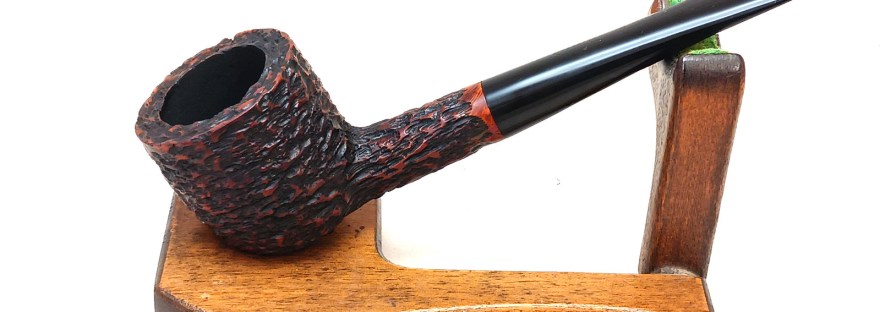
This Lord Pot, reborn as a standard briar pipe, has been returned to active service with its steward where it should perform well for many years to come.
I hope you enjoyed following along with this estate pipe project. Do you have a meerschaum lined briar pipe in your collection that could use a bit of TLC? Perhaps this project might inspire you to get it back into active use once more.
Until next time, Happy Piping! Here’s the finished pipe.


 dadspipes.com