
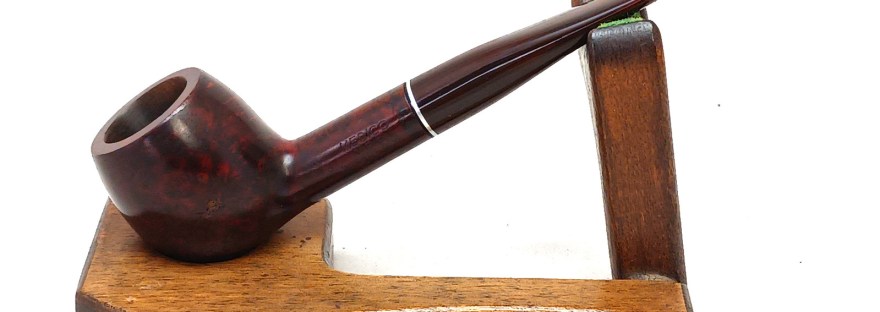
As a restorer and pipe repairman, I am often asked about the value of a particular pipe. On the surface this is a straightforward question about potential resale value, but when one digs into things a bit further, the definition of “value” becomes quite a bit more complicated.
Take today’s pipe, a Medico VFQ Apple, as an example. The Medico brand was established in the USA back in 1933 and is still in production today as one of SM Frank’s best selling brands. Made famous by their disposable paper filters, Medico pipes can be found just about anywhere you find a pipe smoker. The VFQ line was introduced in the 1960s and can often be identified by their Cumberland-like red and black Nylon stems.
According to a vintage advertisement on Pipedia.org, the Medico VFQ sold for a whopping $2.95USD in 1962. Still a low cost option, modern Medico pipes can be found for less than $30USD. This retail value does little to explain why someone might choose to have an old Medico restored; it does not, however, take into consideration the sentimental value of a pipe handed down from father to son, or in this case, grandfather to grandson.
Judging by this initial series of images, this VFQ was a favourite of its previous steward and had the scars to prove it. The rim was battered and bruised from knocking the pipe against hard surfaces to clear the dottle after a smoke, and the stem had some serious tooth dents that stopped just shy of an outright perforation. The gloss top coat on the stummel had long ago worn away, though remnants remained here and there around the bowl. The bowl also sported a rather large fill on the left side which would need reworking to get this old pipe looking its best.


The pipe is stamped “Medico” over “V.F.Q.” over “Imported Briar” on the left shank. The stem also carries the “V.F.Q.” stamp as shown below.

After a bit of discussion, the pipe’s new steward decided to go for a complete restoration of his grandfather’s pipe. The action list was fairly extensive, including a good cleaning, rim rehab, fill repair, bowl refinishing and a new Cumberland Acrylic stem.
With my marching orders in hand, I set to work with a basic cleaning of the stummel. I forgot to photograph this, but the job was straightforward – a reaming of the chamber to remove a light amount of carbon cake, followed by a handful of cotton swabs and pipe cleaners dipped in 99% isopropyl alcohol to clear out the tarry deposits from the shank and airway.
With the stummel clean, I began the rim rehab by topping the bowl very lightly to reestablish a mostly flat rim. A scrap of worn 320-grit sandpaper helped smooth out the inner rim.

I wiped the bowl down with nail polish remover to dissolve the remaining bits of gloss top coat and remove a layer of dust, oils and old wax.

Now that the briar was clean, I started work on fitting the new stem. The pipe’s steward wanted the Medico filter system retained, so first up was extracting the aluminum tenon fitment from the old nylon stem. This pic shows the cleaned bowl alongside the original stem and the new acrylic stem blank.

With acrylic or Vulcanite stems, heating the aluminum would be sufficient to break the joint and extract the tenon. The nylon stem however, just melted over the heat gun, so I had to take a different approach and remove the fitment mechanically. After slipping an appropriately sized drill bit into the filter pocket to protect the tenon from deformation, I mounted the original stem in the lathe and carefully cut away the old nylon. This worked surprisingly well, leaving me with a nice, clean aluminum tenon to transplant into the new acrylic stem.

A short soak in alcohol removed any residue from the tenon, ensuring that the epoxy would bond it securely to the acrylic.

And here is a shot of the component parts of the new stem along with the drill bits required to create the filter pocket and the mortise into which the tenon would be glued. The depth of the filter pocket was arrived at by dry fitting the tenon and a Medico paper filter into the pipe’s shank and measuring the length of the protruding filter.

A quick test fitting told me everything was looking good!


I mixed up a small amount of JB Weld epoxy to bond the aluminum fitment into the acrylic stem. JB Weld has a high heat tolerance, so is a good choice for this job.

After applying the epoxy to the fitment and the inside of the stem mortise, I clamped the pipe upright in a padded vise to let gravity hold everything in alignment which the glue cured.

I left the pipe overnight to give the epoxy full time to cure, then removed the stem and chased the airway to remove the excess glue. As you can see in this pic, the filter fits nicely. I have also roughed in the shape of the new stem, removing the excess acrylic.

With the stem back on the pipe, I sanded it to 2000 grit. A wrap of hockey tape protected the stamps on the shank.

With the new stem ready for final polishing, I turned my attention back to the stummel. It was time to address the battered rim and that big fill. I used a dental pick to remove the old pink putty from the fill and replaced it with a new fill made of briar dust and CA glue. As you can see in these pics, I also applied the patch mixture to the rim. It sure looks ugly at this stage!


Again I left the pipe to rest while the briar dust and CA glue patched cured completely. Then I came back in with files and sandpaper to level the fills. As is often the case, tiny bubbles formed in the patches as they cured, leaving the surfaces slightly honeycombed. A dab of touchup marker coloured the repairs and a coat of thin CA glue filled the micro-bubbles.


When the touchups were cured, I sanded the entire stummel smooth in preparation for the new finish.

To replicate the original colour scheme, I first applied a coat of Black leather dye to the briar, allowed it to dry, then removed as much of it as possible, leaving the black only in the softer grain of the briar.

The top coat of colour was made up by mixing Oxblood and Dark Brown dyes.

Finally, a wipe of mineral oil enlivened the finish and injected some moisture into the briar. I let the oil sit on the stummel briefly before hand buffing away the excess.

Then it was off to the buffer where I gave the entire pipe a run on the Red Tripoli and White Diamond wheels to erase any lingering sanding marks and bring up the shine. A few coats of Carnauba wax replaced the old lacquer topcoat, adding shine and a layer of protection from the elements.
The time on the bench has turned back the clock on this well-loved Medico VFQ, though I was careful not to erase all of the pipe’s character marks. The rim, once beaten and ragged, is now flat and level. The briar glows with a soft sheen and the new finish pushes the large fill into the background. It will always be visible as a fill, but it is far less distracting to the eye. Better yet, the new acrylic Cumberland stem looks like it has always been there thanks to the transplanted aluminum fitment.
This 1960s Medico VFQ is now back with its new steward where it will serve faithfully for many years to come. With a bit of care along the way, it may even be passed down to a third generation of pipe lovers. I’d say that is the real value here.
Thanks for joining me for this rather extensive estate pipe rehabilitation. Until next time, Happy Piping!
Here’s the finished pipe.


Fantastic work!
LikeLiked by 1 person
Thanks very much! It was great to be able to give this pipe the full spa treatment. Good to go for many years to come!
LikeLike
What a great repair on a loved pipe. Great job, Charles. Hope your holiday was bright.
LikeLiked by 1 person