
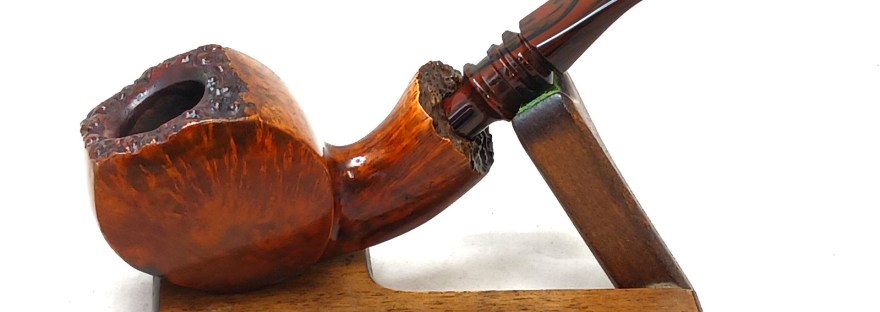
The COVID pandemic disrupted supply chains worldwide as countries sought to limit the spread of the disease. Probably the most well known example of this disruption was the shortage of computer chips used in cars, trucks and vans that resulted in long delays by manufacturers delivering new vehicles to dealerships. Pipe making supplies were also impacted; even now, almost a year after the official end of the pandemic, some parts are still difficult or impossible to source, requiring the pipe maker or restorer to get creative to complete projects.
Such was the case with the pipe on the table this time, a Bari Wiking Handmade that arrived without a stem. This series of images shows the condition of the stummel on arrival at the shop. As you can see, the pipe had seen some solid use. The plateaux rim was packed up with carbon deposits that draped over the rear edge and partway down the rear face of the bowl. The other major cosmetic issue was a burn mark on the left front edge of the bowl – I’d guess the pipe was left a little too close to a lit cigar or cigarette at some point.


The stummel is stamped “Bari” over “Wiking” on the left shank, and “79” on the right shank. The underside of the shank is marked “Handmade” over “in Denmark” in block letters. This stamp is slightly worn, and as you can see, the lower line is double-stamped, making it a bit hard to read.


I consulted the pipe’s steward on a couple of issues, beginning with the burn mark on the side of the bowl. The only ways to truly remove such a blemish is to either sand it out or rusticate the affected area. Neither option appealed to the pipe’s steward, so we settled on smoothing the rough surface slightly without undue changes to the stummel’s profile.
The second challenge with this pipe was the size of the shank mortise. Using my digital calipers, I measured the interior diameter of the mortise at 11.2mm (approximately 0.443 inches). This is a big mortise by any standard, and unfortunately none of the available fancy stem blanks had tenons anywhere near this size.
The pipe’s steward had specifically requested an Acrylic Cumberland stem be fitted to this Bari Wiking. A hand cut acrylic stem was outside of the budget on this project, so it was time to put my thinking cap on. I had Acrylic Cumberland stem blanks in stock in both Round Taper and Round Saddle profiles. Both had sufficient tenon diameter to fit the shank mortise, but I’d need to customize the profile to suit a freehand-style pipe.
While I thought about how best to approach the stem, I took care of the basic cleaning of the stummel. The carbon cake in the chamber surrendered easily to my reamer while removing the deposits from the plateaux rim took a bit more time. Armed with a dental pick, a brass bristle brush and some patience, I eventually got the rim cleaned down to the briar.
Surprisingly, the shank and airway were relatively clean, only needing a few cotton swabs and pipe cleaners dipped in 99% isopropyl alcohol to clear the light deposit of tar from the pipe’s internals.


Cleaned of its draping of carbon, the rear of the bowl proved to be nicely decorated with Birdseye grain.

With the stummel clean and fresh, it was time to get to work on the new stem. I decided to work with a Round Taper stem blank, which I set up in the lathe for shaping. After sizing the tenon end of the blank to fit the shank mortise, I carved a series of decorative rings into the body of the stem blank as shown here.

I made a quick test fit of the stem in the shank. Looking good!

There was still some work to do to really make the new stem pop. As this close pic shows, the lathe left some rough surfaces behind. To smooth things out, I hand sanded the stem with increasingly finer sandpapers from 320 to 2000-grit.

When I had the stem ready for final buffing and polishing, I took a minute to give it an appropriate bend. A pipe cleaner slipped through the stem helps to keep the airway from kinking or collapsing outright during the process. Acrylic takes a bit more heat than Vulcanite to soften sufficiently to bend. Too little heat and the stem will simply snap, while overheating can cause bubbling so I warmed the stem slowly over the heat gun until pliable before introducing the required bend.

When I had the stem bend just right, I set the new shape by running the stem under cold water. When the acrylic was cool and hard again, I removed the pipe cleaner and took the finished pipe to the buffer. I gave both stem and stummel a run on both the Red Tripoli and White Diamond wheels to smooth out any small marks before applying several light coats of Carnauba wax to add shine and some protection for the refreshed pipe.
The finished pipe looks good despite the unfortunate burn mark, and the semi-custom acrylic stem is a great addition. Clean, fresh and ready to go, this restored Bari Wiking should provide its new steward with years of trouble-free smoking companionship.
Thanks for joining me for another estate pipe project. This stem replacement took a bit of creative problem solving, and I’m happy with the outcome. While I can hope that the pre-Pandemic variety of acrylic stem shapes makes an eventual reappearance, it’s good to have alternative solutions available.
Until next time, Happy Piping! Here’s the finished pipe.


 dadspipes.com
Do you repair meerschaum stone pipes? Not the corncob ones but the soap stones.
LikeLike
Hi Joel. Please email me at dadspipesrestorations@gmail.com to discuss your repair. Thanks
LikeLike