
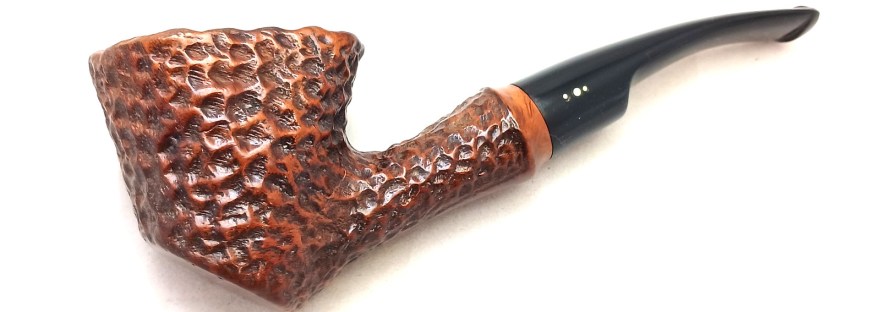
The Brigham Norseman (rusticated) and Valhalla (smooth) pipes were first introduced in the 1960s and were produced until the early 1980s when the two lines were folded into the President series. The pipe on the bench today was made in Brigham’s Toronto factory right at the end of the series’ run.
The pipe was sent in by a fellow Canadian pipe smoker in London, Ontario; as you can see in the pics below, the pipe was in pretty good estate condition with the notable exception of the stem, which had been broken or cut off behind the button. The chamber walls had also been scratched up somewhat, likely by a past steward reaming the bowl with a pen knife.


Twisting the stem off the pipe, I inspected the aluminum tenon. I was very pleased to find that it was in excellent condition and could be transplanted to the new stem.

The stamps on the underside of the shank were fairly worn but legible. The pipe is stamps “9”, then “Brigham” over “Canada”.

The COM stamp dates the pipes to the 1980s, while the shape number code is incomplete (not unusual for this period of production). A quick look at a Brigham brochure from the period identifies the full shape code as “9W6”.

The pipe had obviously been cleaned at some point before it arrived at the shop, but I gave the shank and airway a once-over with cotton swabs and pipe cleaners dipped in 99% isopropyl alcohol.

The scratches inside the chamber weren’t a big concern for me or the pipe’s steward, but a quick sanding helped smooth out some of the lighter marks.


While cleaning the stummel, I discovered a crack in the lower right side of the bowl. This is a natural flaw in the briar, and did not penetrate the chamber. A quick application of CA glue filled the gap and ensured that the crack would not creep. When the glue had cured, I carefully sanded away the excess, taking care not to smooth out the rustication.


With the stummel prepped, it was time to work on the new stem. The Norseman series featured a flush-fit half-saddle stem to further differentiate it from the fancy-stemmed Valhalla pipes. I was lucky to have a handful of these stem blanks on hand. As this pic shows, the new stem is a very good match to the original – and it has a button!

I used the topping board and several grades of sandpaper to flatten the face of the new stem for a good light-tight fit against the shank.


Then it was harvest time! To extract the original aluminum tenon from the old stem, I warmed the Vulcanite over the heat gun until it softened. The centre of the three Dots on this stem was the anchor pin, and a gentle wiggling of the tenon released the pin and allowed me to remove the tenon without damaging it.

A quick cleanup prepped the tenon for installation into the new stem.

Transplanting the original tenon has the advantage of a proper fit in the shank from the outset, which can be a real time saver. After slipping a Brigham Rock Maple filter into the tenon, I mounted it in the pipe’s shank and took some measurements. The new stem required a filter pocket of 3/16″ diameter drilled to a depth equal to the distance from the far end of the knurled section of tenon to the end of the filter.

Marking my depth on the drill bit, I bored out the airway to accommodate the filter, then drilled a second time to create a mortise into which I would glue the stem end of the tenon. This pic shows the multiple drillings.

A quick test fit with the filter in place showed that I had drilled the stem correctly.

I removed the filter, then applied a bit of two-part epoxy to the stem mortise and slipped the stem into place over the tenon. I held the pipe together for a few minutes until the epoxy took hold, them clamped the pipe upright in a padded vise to cure overnight. A few pieces of masking tape held the stem in position while the glue cured.

When I came back to the pipe the next day, I removed the stem and chased the airway with a drill bit turned by hand to clear any excess glue. This pic shows the stem with the original tenon in place. The marks on the stem’s left flank serve as a rough layout of the brass Dots I’d install next.

The pinning pattern for a Brigham Norseman is a linear arrangement of two small brass Dots flanking a larger centre Dot. These were traditionally drilled freehand by the Brigham production staff, so that is the way I also drill them. For this stem, my drill press chuck would not hold a 1/32″ drill bit to make the smaller pin shafts, so I mounted the drill bits in a pair of pin vises and drilled the pin shafts freehand.

A drop of CA glue in each hole bonded short sections of brass rod in place. After the glue had cured, I filed and sanded the pins flush to the Vulcanite.

The new stem needed a bit of hand sanding to remove the casting marks and smooth the surface. I sanded the stem with 220 through 2000-grit papers then took the finished pipe to the buffer for a run on the Red Tripoli and White Diamond wheels. A few light coats of Carnauba wax brought up the shine and added a layer of protection from oxidation.
The finished pipe is looking great after its time on the bench. In good shape to begin with, the new stem completed the pipe’s restoration and will allow the pipe’s current steward to enjoy it properly for the first time.
I hope you enjoyed following along with this estate pipe repair project. Until next time, Happy Piping! Here is the finished pipe.


 dadspipes.com