
Filtered pipes have been around in one form or another for decades. According to this article on Pipedia.org, the Dr Grabow paper filter was first patented in 1932. This was not the first such paper filter on the market, however; the German firm Vauen introduced the Dr Perl paper filter more than a decade earlier in 1921, followed in 1934 by the invention of the world’s first 9mm activated charcoal filter.
Since it’s launch, the 9mm charcoal filter has become a mainstay of filtered pipe manufacture and most of the larger pipe makers now offer at least some of their pipe models kitted out with the filter. In Germany today, the vast majority of pipes sold include the 9mm filter system.
The 9mm filter comes with its own set of challenges. By default, the tenon on a 9mm filter stem is large, somewhere in the 11mm range, which restricts the system’s practical applications to pipes with stouter shanks. There also now exist many different brands of 9mm filter that, despite the label, can vary slightly in length and diameter. This variation in size can cause headaches for filtered pipe lovers trying to find filters that fit their pipes properly.
From a repair viewpoint, a 9mm tenon can be a bit of a bear to replace. While non-filtered Delrin replacement tenons can be ordered from such pipe supply houses as Vermont Freehand or JHLowe, a 9mm replacement tenon must be made up in-house, custom fit to each pipe – a process I have come to associate with tedious manual adjustment of both internal and external diameters.
Thus, when I was contacted by a fellow Canadian pipe lover inquiring about a 9mm stem repair on an Italian-made Stefano Exclusive Tomato, I began mentally preparing for the job. When the pipe arrived in the shop, I took this initial series of pictures. As you will see, the pipe was in pretty good estate condition, though some TLC was in order to get the pipe looking and performing its best again.
The pipe showed a ring of carbon “lava” around the rim of the chamber, and I had a sense that it had not been used in some time. The exterior was grimy with old wax, dirt and oils but the vertical grained briar was hard to miss underneath. The stem was also dirty, with a hash of small handling marks and a few tooth dents.


The pipe is stamped on the left shank with “Stefano” over “Exclusive” and on the right shank “Selected” over “Briar”. The stem is marked with a Crown logo on the upper surface of the saddle stem near the shoulder.


A little research showed that the Stefano brand belongs to the Italian pipe making firm of Santambrogio, founded in 1912. According to the entry on Pipephil.eu, Stefano pipes are made specifically for export to the German market.
Now that I knew what I was working with, I moved on to cleaning up the pipe. I realized why the pipe had been sent in for work when I tried to remove the stem from the shank. Instead of the tenon twisting out of the shank, the stem came free of the tenon, which was stuck tight in the shank mortise. After a little work with alcohol to dissolve the offending tars, I managed to extract the tenon and took this shot of the component parts of the pipe – stummel, tenon, a decorative brass trim ring and the acrylic stem itself.

I believe what happened here to be the result of a combination of inadequate regular cleaning and an insufficient amount of adhesive used to secure the 9mm tenon into the stem face. Essentially, the buildup of tars in the shank overcame the weaker glue joint, leading to the failure shown above. Thankfully, the repair is straightforward enough, beginning with a good cleaning.
I began the process by reaming a light amount of old carbon cake from the chamber. The reamer gets the worst of the cake, while a bit of sandpaper wrapped around a dowel helps to smooth out the remainder. The chamber walls and floor were in good condition under the cake.

With the chamber clear, I got stuck in with 99% isopropyl alcohol and a handful of pipe cleaners to clear out a fair deposit of tars and other goodies from the shank and airway. A shank brush cuts down on the number of pipe cleaners required.

Wanting to be certain that all of the old tars had been removed from the stummel, I packed bowl and shank with cotton wool and filled the pipe with fresh alcohol. Left to sit overnight, the alcohol would work on the deeply ingrained deposits, dissolving the tars and capturing them in the cotton wool. In this pic you can see that the alcohol has already started its work, discolouring the cotton wool in the shank.

I came back to the pipe the following morning and removed the now soiled cotton wool from the stummel. My work here was not done, however, as a test pipe cleaner came out of the shank dark with tars. I cleaned the stummel’s internals again with alcohol, pipe cleaners and cotton swabs, scrubbing the shank and airway until I was sure the pipe was clean.

Only then could I reassemble the stem, using a small amount of two-part epoxy to bond both the tenon and brass trim ring into place.

I allowed the epoxy to cure, then chased the filter pocket with a drill bit turned by hand to remove any excess epoxy from the cavity. I gave the upper and lower bite zones of the stem a quick sanding with 320-grit paper, then drop-filled the deeper tooth dents with black CA glue.


Again, I let the work sit while the glue cured, after which I filed and sanded the fills flush with the stem. I hand sanded the stem to 2000-grit to prepare it for final buffing, refreshing the Crown logo with a white filler crayon while I was at it.

All that was left to do now was to take the pipe to the buffer for a run on the Red Tripoli and White Diamond buffs followed by a few light coats of Carnauba wax to add shine and protect the revitalized pipe.
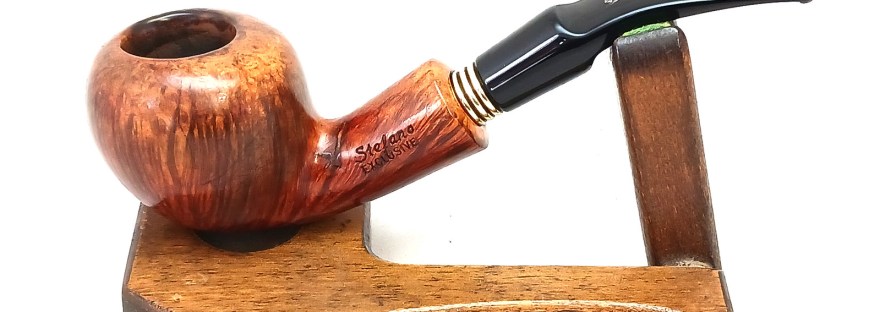
The completed pipe is once again ready for action. The stummel is clean and fresh, free from the odors of old tobacco tars, while the acrylic stem once again shines a deep glossy black, set off by the bling of the brass trim ring. Better yet, the 9mm tenon is now securely attached to the stem, preparing the pipe for many years of trouble-free smoking companionship.
Thanks for joining me for this little foray into the history of 9mm filters and the reasonably quick rehabilitation of this Stefano Tomato. Until next time, Happy Piping!
Here’s the finished pipe.


 dadspipes.com